Home Blog Page 383

2008 Sno Pro 600 – A Whole New Animal

Originally published in PRIDE Magazine

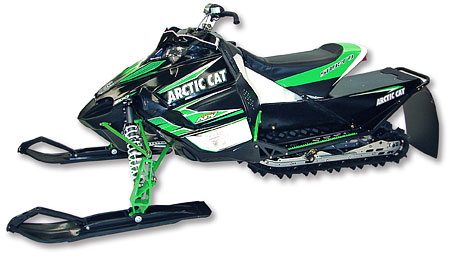
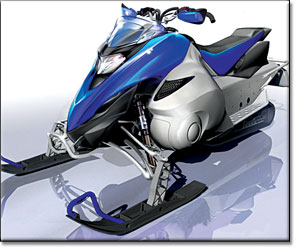
For the first time since the 2002 season, Team Arctic racers will enter their battles aboard an all-new race sled: the Sno Pro 600.

The culmination of an intense engineering effort aimed at creating the ultimate terrain racer, the newest Sno Pro continues the long tradition of being both a sled designed to win races and test new engineering concepts.

Notice the emphasis on terrain.

“From the beginning, this sled was designed for both snocross and cross-country success,” said Brian Dick, Engineering Project Lead for the sled and a fiery cross-country veteran to boot. “Other goals included minimizing chassis scrub when going through deep holes, and incorporating a 600 engine to conform to the new Stock class racing rules for the 2008 season.”

A year ago, Team Arctic Race Manager Russ Ebert spoke of the company’s refocus on cross-country, and backed up his talk with a lucrative contingency program in the growing USCC circuit. The new Sno Pro 600 is another example of that commitment.

So what’s it got? Plenty!

For starters, underneath the stylish new hood is an all-new tubular chassis, utilizing a combination of 4130 chrome-moly and extruded aluminum to form a pyramidal structure that holds the motor, in addition to supporting the front suspension, steering posts and tunnel attachment.

The choice of a tubular chassis instead of a traditional bulkhead, and the use of self-piercing rivets instead of welding, is aimed at increasing chassis rigidity against the incredible forces inflicted during competition.

The front suspension is also new, with extruded spindles utilizing ball-joints rather than a spindle and housing configuration, relocation of the shock mounts to the lower A-arm and revised A-arm geometry.

“We went with a single spindle with ball-joint operation was to shed weight, and because it allowed us to use a longer spindle, which also raised the sled’s ground clearance,” said Dick. “The new geometry has the spindle travel in an up/down trajectory, rather than sweeping rearward during compression, for improved cornering.”

Equally important, the rear suspension is mounted two inches forward compared to the previous Sno Pro, effectively shortening the “wheelbase” by the same distance. In concert with increased steering angle, the result is a tighter turning radius. The Progressive Steering System and dual-position steering post mounts return from last year’s Sno Pro. C&A Pro skis come standard.

Out back, the Slide Action rear suspension returns with a new, more aggressive rail profile for increased traction. The track is a new 15 x 128 x 1.7-in. Camoplast hoop, with an optional 1.25-in. Cobra hoop for cross-country. Fox IFP shocks are used on the front and rear suspensions.

The new tunnel is wider to accept the 15-in. track, with revised running boards that are wider and flatter than other models, and that have a snow-shedding, open-hole design. An all-new seat is slightly wider and softer than the previous Sno Pro (a nod to the cross-country racers), while the seat base is now integrated with the fuel tank, available in either a 7-gallon unit for snocross or a 12-gallon unit for cross-country.

Powering the new Sno Pro is a heavily tweaked version of the 600 laydown twin used in the F Series. It features a new crankshaft that’s 5 lbs. lighter for quicker revving and higher performance. EFI is gone, replaced by dual 40mm TM flatslide carburetors (with throttle position sensors) for easier tuning.

The V-Force Reed Valve system is employed, as is a new cylinder head, ceramic-coated exhaust pipe, adjustable timing module and Hot Start button. The engine requires pre-mixing oil, and is capable of running on 92 octane fuel. A front-mounted heat exchanger and tunnel-mounted exchangers provide adequate cooling for both snocross and cross-country.

Transferring the power from engine to the track is an Arctic Cat drive clutch, TEAM driven clutch and Peak Torque Limiting System driveshaft, a combination proven bulletproof on last year’s Sno Pro Mod sled. New, however, is a higher driveshaft location for increased ground clearance.

A new hood graces the Sno Pro 600, featuring a very short nose structure – again, a nod toward reducing scrub/scooping in certain situations. Removable side panels ease accessibility to either side of the engine.

Two windscreens are available, a short (as shown here) and tall version. The sled comes without the standard digital/analog instrument gauge, but it’s ready to plug-and-play.

Racers and engineers who have tested prototypes of the new Sno Pro are unanimous in their praise for its handling, emphasizing its neutral manners in all conditions.

With a rider position that’s nearly identical to the Twin Spar chassis, the ride quality is extremely forgiving and comfortable, and easily adaptable. With a 450-lb. dry weight to meet racing specs, it’s quite flickable. And with two inches more ground clearance, it bashes through the big holes without scrubbing speed.

While there are no plans to make a consumer version of the Sno Pro, it’s clear that the company is using the sled to test new concepts that may someday see full production.

“There are many elements of the new Sno Pro that we’re evaluating for future use,” said Doug Wolter, Director of Engineering.

Production of the Sno Pro 600 is limited to 300 units, and all have been spoken for by Team Arctic racers. For racers who want an Open class sled, a Speedwerx-developed Mod kit includes revised cylinders, new cylinder head/domes, billet exhaust valves, a new exhaust system, and carb/clutch calibration.
TAILLIGHTS: Volume 18, #4

0

NORMAL WEATHER

We recently had a request for CJ Ramstad’s last column before his passing. This is a great read for snowmobilers relating to the weather and false claims made by environmentalists. Below is the article in its entirety from Supertrax Volume 18, #4.

I was mailed an unrequested fundraising 2007 calendar from one of the green groups recently that declared on its cover that the Earth is experiencing the warmest weather in 1000 years. Silly on many levels, this is the kind of trash we hear more and more lately.

Is this a case of a snowmobiler in denial? Fact is, I’ve spent the last 18 months studying the Arctic and the polar ice cap as part of research for my book about the snowmobilers who went to the North Pole in 1968. I know from my studies these kinds of over-the-top statements about our climate and where it’s going are bogus … and I have proof.

First, let’s do the math. A thousand years ago, it was 1007. The thermometer wasn’t even invented until 1724 so any temperatures reported before then are, by definition, approximations and guesswork. It is possible to tell if one season centuries ago was warmer than another by testing for changing values of oxygen-18 isotopes in glacial ice cores. Scientists know warmer weather creates more of the isotope, cooler weather produces less. But the cores don’t tell the ancient temperature.

We know from the Icelandic Sagas descendants of the Vikings were raising rye and ponies in two colonies on Greenland in 1007. Things were different in Greenland then at least partly because the Earth was right in the middle of an era scientists and historians call the Medieval Warm Period.

This is a well-documented climate change event today’s global warming folks would like you to ignore. Starting in about 800 A.D., this was a seven centuries-long time of warm weather on Earth’s northern hemisphere that persisted until the advent of the Little Ice Age that held much of the world in its grip from about 1400 until the mid-19th century. Mind you, this was all happening well before humans were emitting any greenhouse gasses.

It was during the Medieval Warm Period that much of the North Atlantic Arctic was explored or at least defined by sailing ships. The Vikings got started in about 600, plundering Scotland and England and colonizing Iceland and Greenland for the next 500 years.

But with the coming of the cooler Little Ice Age period, human activities in the high latitudes dropped off. The Vikings got religion, the European Greenlanders disappeared and ice choked the northern seas.

Interest in the Arctic picked up in the 19th century when the oceans warmed up again. Whalers sailing the northern oceans as the Little Ice Age was coming to an end reported lots of melting in the high latitudes, similar in some ways to what we hear today.

One famous Scottish whaling captain, William Scoresby, Jr., reported in his Account of the Northern Region that the ice that today blocks the straits between the Nordic island of Svalbard and the northern coast of Greenland was gone, making him believe a passage by ship over the top of the island was possible. That melting was witnessed in 1817, less than 200 years ago.

Failed presidential candidate Al Gore has been on TV showing movies of glaciers calving in Greenland, saying this is proof of global warming. Increased calving is actually proof of increased snowfall in glacier areas, but I’ll give Gore this much: It is possible, even likely, the climate is changing in Greenland now, just like it has in the relatively recent past. I mean relatively like during the time we’ve been flying around in airplanes.

It’s known that sea temperatures around the island warmed early in the last century, causing problems for seal hunters. This warming turned out to be short term however, and seas turned cooler again by the 1950s and good seal hunting returned, along with increased Inuit habitation, in southern Greenland.

Just 40 years ago, during a period between 1959 and 1974, exceptionally cold weather was experienced in southern Greenland, particularly along the western coast where the icy West Greenland Current flows south out of the Arctic Ocean. During this 15 year period seal populations again plummeted, this time because persistent summer pack ice prevented the previous migratory feeding behavior.

Mind you, these changes have taken place during the lifetimes of people living today. A warm-up during the Roaring Twenties, a cooldown in the 1950s, a really cold period in the 60s and early 70s, all taking place in Greenland within the last 80 years. This is a place with a volatile climate that has seen many changes in the last 100 years and the last 1000 years, too.

The polar ice cap is also volatile weather-wise, but Al Gore is no expert on this and neither are Americans in general; the U.S. only began collecting data on the ice cap in 1979 just as the second-coldest period in the Arctic in a century was coming to an end. Was the ice abnormally expanded by this cold period and is now shrinking?

But let’s not say abnormal, OK? The weather is always normal … constantly changing in Greenland, Minnesota, at the North Pole and everywhere.

FX NYTRO: FROM SKETCHPAD TO YOUR PAD

0

How the FX Nytro Went from Concept to Reality

Even though the product planning brains of a company know what they want a sled to be in terms of power, suspension and ergonomics, it still has to be styled and designed to appeal and perform.

Yamaha Product Manager, Adam Sylvester explains: “Yamaha has a very involved design process. We start with a table full of concept sketches and drawings and begin to whittle them down and combine elements into just a handful of options. From there, the final concept gets rendered in multiple views and serves as the guide.”

While the beauty techs work on colors, lines, textures and graphics, the mechanical testing team is cranking away on proving designs, testing setups and getting the prototype sled ready for its final approval.

“The whole time each of the teams are working on their respective areas, they communicate necessary changes. For instance, all of the early design work had curved lower A-arms on the front suspension. In the end, the testing and engineering team opted to go with a straight design. The sketches are not iron-clad. It’s a very fluid and dynamic give and take process.”

When the mechanicals are nearly complete, the project enters the ergonomic fitting. Sylvester adds: “We have a number of processes we use to determine the final dimensions and shape of the consumer product. For the FX Nytro, since we wanted it to have a very racer-like feel to it, we brought in two of our racer/test drivers to use as models. They got on the full-scale clay models and moved around as if they were in a race. In that way, we are able to identify any ergonomic issues like hard edges hitting knees or awkward handlebar angles.”

Once the final body sculpting is complete and the color and graphics decisions have been made, the clay model is dolled up and presented for the final approval.

“It’s amazing how close the final product resembles the initial concept sketch on the FX Nytro,” Sylvester commented. “It just shows how much thought goes into product development right from the start.”

Read “THE PERFECT SNOWSTORM: An Exclusive Look at Yamaha’s 5-Year Plan To Launch The FX Nytro” in Supertrax Volume 19, #2.

Polaris Announces Product Updates for 2008

Press Release –

Polaris announces a few key product updates for 2008 sleds:

800 Dragon RMK 155 / 163

Timing for delivery to dealerships is currently on schedule and Polaris will be sending out a letter to that affect.
• Shipments to Western / Rocky Mountain Region including North and South Dakota will begin the first week of December, starting with 163” models followed by the 155” models. Most shipments should be completed by Christmas.
• Shipments to Midwest and Eastern dealers will begin in January 2008.

MY08 800 IQ 121” Change:

• This model will now be an 800 IQ (base model, not in Dragon trim)
• begin shipping mid-late January 2008.
• Key changes
o MSRP $9,699 USD, $12,599 CND
o Color Black
o Track 15 x 121 x 1 Hacksaw
o IFS Shocks RydeFX HPG, IFP
Note: Other feature changes consistent with IQ vs. Dragon IQ brochure specifications (pg. 8- 9).

• Product enhancements
o IQ graphics
o NEW Lightweight Freestyle seat
o NEW improved ergonomic fuel tank (11.5 gallon / 43.5 Liter)
o NEW Lightweight cooling system – no perimeter (running board) cooling, smaller front bulkhead cooler.

Other MY08 Product Updates:

• 600RR – will come standard with reverse (PERC).
• 600 IQ Touring – will come standard with a single carbide for improved handling / cornering.
• FS and FST IQ Touring models come standard with dual carbides.
• Widetrak LX – will come standard with an 11 gallon / 41.6 Liter fuel tank (same as 2007).
• Clarification – 600 / 700 Dragon Switchback models come standard with a grab (mountain) bar in lieu of hand guards (brochure pg. 14-15).
• Hand guards are standard on Dragon IQ models.

Is There A New Doo Coming Mid Season?

Question:

Dear Motorhead,

Is it true there is a new 600 power plant for Ski-Doo coming out mid season?

Coop

Response:

Thanks for your email!

Your question is likely coming from the announcement of the new 600 RS XP racer-only platform which uses a hybrid Rotax 600 carb.

The engine is not really “new” but is a conglomeration of pieces from existing mills to create a very potent “new” 600 ISR race spec, stock class sno-X engine. The motor is claimed to produce near 130 HP.

One has to assume Ski-Doo’s competitive nature and their continued use of sno-X developed technology as a test bed for improved trail sled technology would make a reasonable argument for this new mill to show up in a trail sled. However, don’t expect to see it as a limited build this year.

We think you’re on the right track but if this engine appears it will likely use SDI – EPA certification is a driving factor in consumer engine technology. Welcome to the new world of clean-air snowmobiling!

The good news in all this – I suspect – will be a more powerful 600 SDI 2 stroke in MY 2009.

Notice I did not say Ski-Doo will not have a limited build 600 class engine this year. Stay tuned.

Motorhead Mark

I.P.C. E-Z load Ski Ramps

When you’re worn out after a great day of trail riding any bit of help you can get while loading your sled back onto your trailer makes a world of difference.

The new E-Z Load Ski Ramps from IPC give that little extra to make loading onto your trailer that much easier.

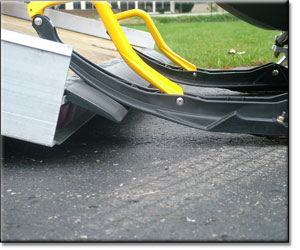
E-Z Load Ramps are made from polypropylene to resist wear and cold weather breaking. They’re designed to create a smooth loading process no matter what surface that you are parked on.

With the combination of lifting your ski and the plastic being a natural lubricant your sled loads easily. Plus you won’t catch your carbides while loading and unloading.

The E-Z Load Ramp is designed to fit 101″ tilt trailers, but can be trimmed to fit any trailer width.

5 piece kit is $49.95 and the 3 piece kit goes for $29.95.

Call 574-784-2070 and visit www.injectionplasticsmfg.com.

Polaris Currency Exchange Statement

Polaris Responds to Cross Border Sled Buying With Rebates For Canadian Buyers

Press Release –

Polaris is a global company. Currency fluctuation is often a challenge for manufacturers and dealers alike and there is no perfect solution.

Currency fluctuation is usually a temporary situation that corrects itself over time.

Polaris’ policy is not directed at Canadian consumers or the citizens of any particular country.

Polaris prohibits all dealers around the world from actively selling across borders for a variety of regulatory, marketing and distribution reasons.

Polaris has not altered its policy against selling across borders. This policy has been in effect for many years.

Polaris has acknowledged the historic currency fluctuation between Canada and the United States by rolling out a Canadian exclusive retail program including rebates of up to $1,000 (depending on model), effective November 1, 2007.

These programs neutralize the cost to the Canadian consumer and strongly encourage Canadians to purchase in Canada.

Moreover, Polaris’ pricing and programs are very competitive in the marketplace.

LowPro Trailer Guides

0

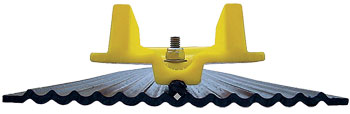
Caliber LowPro low-profile trailer guides and protection system saves your trailer decking from damage caused by carbide ski wear.

Loading is effortless with friction-free 100% HDPE construction.

The design allows for multiple-season use without removing the glides. LowPro trailer guides are available in standard 6” and wide 8” for skis with dual wear rods.

Call 1-800-970-3502 or visit denniskirk.com.

Sno-Stuff Rumble Pack Silencers

0

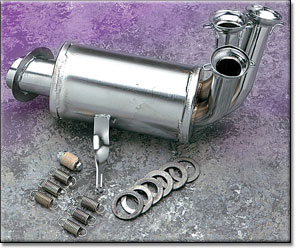
Rumble Pack silencers offer more boost and less weight with the industry’s first Dual Stage acoustical design.?

Kits attach to your stock exhaust pipes and include complete instructions. Triple and single canister designs are available.

Call 1-800-970-3502 or visit denniskirk.com.

New Speedwerx Springs

0

Speedwerx knows a thing or two about performance snowmobile set-ups.

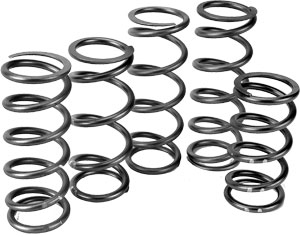
H-5 Alloy Springs are now available for clutches, suspensions and even 4-stroke valve trains.

These springs are up to 35 percent lighter than chrome silicon units and perform the same as titanium springs at a fraction of the cost.

Speedwerx claims these springs will maintain consistent clutch performance and are highly resistant to rate loss when compressed.?

speedwerx.com