Home Blog Page 131

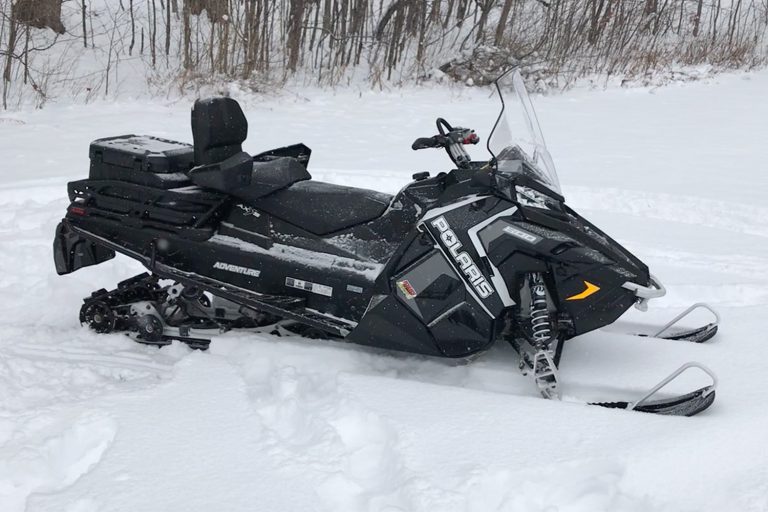
2018 POLARIS SWITCHBACK XCR

0

One of the sleds we got to sample late last season was the 136-inch Switchback XCR.

This version of the XCR is available with either 600 or 800 Cleanfire power and, as much as we like the 120-inch version of this sled, we absolutely love this longer one.

Polaris has done a good job with the XCR’s shock package to make it a performance-centered model while still allowing excellent trail compliance without harshness.

Actually, the shock setup sounds pretty techie: Compression adjustable Walker Evans piggybacks up front and on the skid’s front arm, and a big compression adjustable W-E piggyback Needle at the rear.

You can adjust these shocks big-time to get exactly what you want, but we found the stock set-up was very good.

It feels like the 136 handles trail moguls and chop better than the shorter track and we didn’t find much difference in the way the two track lengths steered in tight stuff. The AXYS platform is a great handler anyway and all the geometry works to give you excellent feedback through the handlebars.

As for our preference of engines – 600 or 800 – it really depends what you want. The Cleanfire 600 is a very strong semi-direct injected (SDI) powerplant with excellent throttle response and significant pull in the midrange.

The 800 is definitely more brawny, still very well-behaved, and it can pull stronger mph up top than the 600. If you’re like me and actually prefer the 600 class, anyway, this is a great example.

All XCRs use a 1.35-inch-deep track and although it’s very good, and quite versatile, we’re hoping Polaris will eventually move up to a 1.6 – at least on the powder-snow targeted 136.

We think the XCR represents the highest evolution of the AXYS platform and strongly recommend it.

Elias Ishoel Out For Snocross Season Opener

Jimmy John’s/XPS/Ski-Doo racer Elias Ishoel will miss the first four rounds of the ISOC national snocross tour while he returns home to Norway to continue rehabilitation of a leg injury.

Ishoel, a rising star in the Pro ranks and recent signing to the Boss Racing Team, suffered a broken femur in July and, while he has been training and was in Minnesota testing with the team, has determined that he is still unfit to ride at 100% under racing conditions.

Ishoel will sit out this weekend’s event at Spirit Mt. in Duluth, Minnesota, along with rounds three and four in Jackson Hole, Wyoming before returning to the team after the holiday break.

At this time he is expected to be ready to rejoin the series at rounds five and six in Shakopee, Minnesota on January 5-6.

teambossracing.com

HIBBERT READY FOR DULUTH

Tucker Hibbert will enter his 18th professional snocross season this weekend in Duluth, Minn. at the first stop of the 2017/2018 ISOC National Snocross tour. The 26th annual Duluth National kicks off the eight-stop, 17-round tour that’s rooted in the Midwest and stretches from the Rocky Mountains to the Northeast U.S.

Hibbert, a 10-time national champion in the series, is determined to reclaim the title after finishing third in last year’s year-end points championship.

Hibbert’s had unrivaled success at the season opening event on Spirit Mountain’s ski hill. In his 14 professional appearances, he’s lined-up for 28 final events; taking home 16 victories, 25 top-five finishes and placing outside the top-10 only once.

Pro racing action at the Duluth National takes place Friday, Saturday and Sunday. The races will be streamed live on snocross.com/livestream and delay broadcast on CBS Sports Network. For more information on Hibbert, visit tucker-hibbert.com.

Memories at the Duluth National:

“”It’s pretty nuts to think about all the laps I’ve done around Spirit Mountain – on the track and in the pits and chalet as a kid. I’d assume I have more laps total around that place than any one else. I have a lot of memories at Spirit Mountain and it’s always fun to go back.”

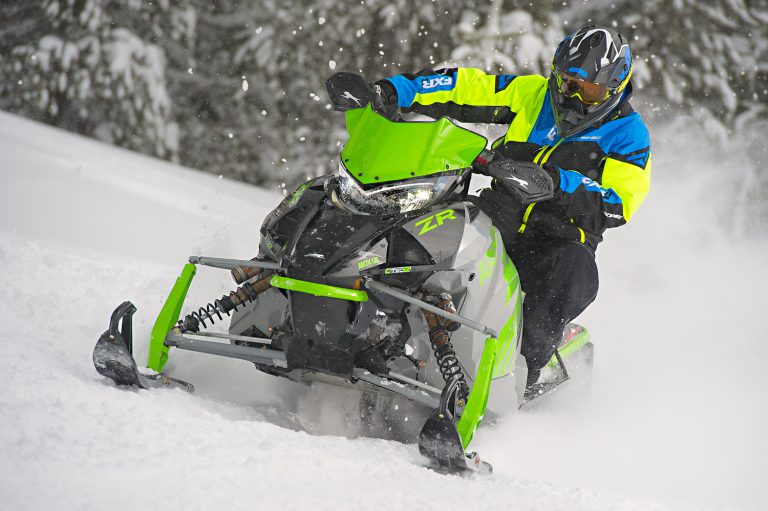
Thoughts on 2018 Arctic Cat ZR 6000R SX race snowmobile:

“I’m really excited about my new race sled. We made a ton of changes during the off-season and I feel like it’s the best race sled I’ve ever had. I’m stoked to get to the racetrack for the first time with it. I worked closely with Arctic Cat and their engineering group, like I always do, but this year was a little different with the stock rule. Since we can’t make any changes to the sled, it was more important for us to work even closer this year. We spent a lot of time taking what we learned last year on the track, tested new ideas in the spring and early summer and got it fine-tuned before production. It’s been a lot of work but I’m happy with the results. It’s an awesome machine.”

Note: For the 2017/2017 season, ISOC moved from open class to stock class racing.

Goals for the season:

“My main goal is to win the championship. To do that, I have to win a lot of heat races and main events. Last year, I won the most main events but didn’t win enough heat races. I need to focus on doing both this year to win the championship.”

Note: Points for the year-end championship are awarded in both the heat races and main events. Additionally, the winner of each heat race is awarded bonus points; putting extra weight on winning qualifying races.

Tucker Hibbert – Duluth National Statistics

15th Pro Appearance at the Duluth National

2016 – Pro Open 1 – 3rd, Pro Open 2 – 1st (raced in Shakopee, MN)
2015 – Pro Open 1 – 1st, Pro Open 2 – 2nd
2014 – Pro Open 1 – 1st, Pro Open 2 – 1st
2013 – Pro Open 1 – 1st, Pro Open 2 – 1st
2012 – Pro Open 1 – 5th, Pro Open 2 – 5th
2011 – Pro Open 1 – 4th, Pro Open 2 – 3rd
2010 – Pro Stock – 1st, Pro Open – 1st
2009 – Pro Stock – 1st, Pro Open – 1st
2008 – Pro Stock – 1st, Pro Open – 1st
2007 – Pro Stock – 6th, Pro Open – 1st
2006 – Pro Stock – 11th, Pro Open – 5th
2002 – Pro Stock – 1st, Pro Open – 7th
2001 – Pro Stock – 3rd, Pro Open – 1st
2000 – Pro Stock – 2nd, Pro Open – 1st

26th Annual ISOC Duluth National Pro Racing Schedule

Friday, Nov. 24 – 5 p.m.: Dominator head-to-head competition for $10,000
Saturday, Nov. 25 – 5 p.m.: Pro 1 Opening ceremonies, qualifying and final
Sunday, Nov. 26 – 12 p.m.: Pro 2 Opening ceremonies, qualifying and final

2017/2018 ISOC National Snocross Tour Schedule

Duluth, MN // November 24-27, 2017
Jackson Hole, WY // December 8-9, 2017
Shakopee, MN // January 5-6, 2018
Deadwood, SD // January 19-20, 2018
Salamanca, NY // February 16-17, 2018
Mt. Pleasant, MI // February 23-24, 2018
Dubuque, IA // March 9-10, 2018
Lake Geneva, WI // March 16-17, 2018

Tucker Hibbert, 33, entered his first race at the age of eight and today stands as the most decorated snowmobile snocross racer in history. He’s a two-time FIM World Snowcross champion, 14-time X Games medalist and 10-time national snocross champion. Now in his 18th professional season, he holds 127 Pro National victories.

For more information on Hibbert, visit tucker-hibbert.com.

POLARIS SIGNS DEAL WITH HENTGES RACING

Polaris Engineered Lubricants has signed on as sole lubricants partner to Hentges Racing for the 2017-2018 and 2018-2019 snocross race seasons.

The two-year deal means 2017 Pro Open champion Kody Kamm and 2017 Winter X Games Snocross gold medal winner Petter Narsa will use Polaris Engineered Lubricants exclusively in their pursuit of Pro class championships.

“Hentges Racing is extremely excited to be working with Polaris Engineered Lubricants,” said Hentges Racing Team Owner Nate Hentges. “Our team is really looking forward to using Polaris Engineered Lubricants race oil again. When we switched to the other brand of oil a couple seasons ago, they had to basically rip the Polaris oil out of our cabinets. We’re glad to be back!”

“No one knows the needs of Polaris race engines better than the engineers at Polaris Engineered Lubricants,” said Polaris Snowmobile Race Manager Tom Rager Jr. “With the new stock rules we’re looking for every advantage we can get, and I know Polaris Engineered Lubricants will give Polaris riders an edge as we look to win more snocross championships this season.”

Engineered for racing and severe duty applications, Polaris Engineered Lubricants are specifically formulated to protect Polaris Liberty race engines in competition use and high-performance consumer use.

Polaris Engineered Lubricants are aimed at the lubrication needs of modern high-performance snowmobile engines and have been tested and proven to perform in and protect engines under the most severe conditions.

For more information visit lubricants.polaris.com/en-us/shop/lubricants or see a Polaris dealer.

Polaris Industries Inc. (NYSE: PII) is a global powersports leader that has been fueling the passion of riders, workers and outdoor enthusiasts for more than 60 years. With annual 2016 sales of $4.5 billion, Polaris’ innovative, high-quality product line-up includes the RANGER®, RZR® and Polaris GENERAL™ side-by-side off-road vehicles; the Sportsman® and Polaris ACE® all-terrain off-road vehicles; Indian Motorcycle® midsize and heavyweight motorcycles; Slingshot® moto-roadsters; and Polaris RMK®, INDY®, Switchback® and RUSH® snowmobiles. Polaris enhances the riding experience with parts, garments and accessories, along with a growing aftermarket portfolio, including Transamerican Auto Parts. Polaris’ presence in adjacent markets globally include military and commercial off-road vehicles, quadricycles, and electric vehicles. Proudly headquartered in Minnesota, Polaris serves more than 100 countries across the globe.

Visit polaris.com for more information.

BEST SLED FOR MY WIFE

Hey Mark,

Hope things are going well and you are looking forward to another great season on the snow.

You were such a huge help on providing great feedback for my sled purchase last season (and I can tell you this the choice was a great one) I thought I would run by our new search for my wife by you.

She has been riding a 1997 Cougar since we bought it new 20 years ago and I think I finally have her convinced that she can let her love and sentimental feelings towards this sled go and move into the new era of snowmobiling.

I have located a nice 2013 F1100 LXR non turbo with 1700miles for under $7,000.00 without a mark on it. I remember you saying to stay away from the Turbo models in these years and also the longer 137 track. This has a 129″ and seems very clean. I watched a few of the SnowTrax reviews online and it seemed you guys liked the sled back in 2012 and even more in 2013 with the re-calibrated suspension.

She likes comfort and going quick but not blazing fast so no need for worries of getting over a C-note.

Any thoughts?

Norm

Hi Norm!

Good to hear from you!

We too are excited about the coming season – snow forecast here for tomorrow! Yahoo!

Seeing as how we have talked many times in the past I’m going to be brutally honest with you about the sled you’re thinking of for your wife.

While the 1100 Suzuki mill was bulletproof and fairly fuel efficient it is not light. In fact that sled is down right heavy compared to your wife’s vintage Cougar and all the other AC iron in your stable. Here’s my point. Why do we men think our wives would want a ji-normously heavy snowmobile?

So many guys think the ultimate ride for their wives is a 4 stroke. Trust me – it isn’t! With your wife’s background on the Cougar moving her onto an F-1100 is going to be like moving from a Chevy Cruise to a Buick Roadmaster. If she gets stuck – forget it. If she gets out of shape after hitting a sucker bump forget it!

My wife loves to snowmobile but I tried the 4 stroke thing on her and it ended badly. My wife – for the record – doesn’t know the difference between a 2 stroke and a 4 stroke – however she absolutely knew the diff between heavy and light.

My solemn advice is to look for a nice 600 DSI AC. They are light, torquey and easy to ride. They are also actually better on fuel than the F-1100 which strangely never excelled in that department.

Hope I haven’t upset the apple cart for you however I am confident you will be a hero in your wife’s eyes (happy wife, happy life) if you move her onto a lightweight, easy to ride and handle AC.

Thanks,

Mark

WILL CAT RESPOND WITH AN 850?

0

Arctic Cat’s new DSI 800 is a great engine and meets the requirements of the market quite nicely, thank you. We’re excited about putting some long miles on our press copy this winter.

However, Ski-Doo threw a crescent wrench into the plans of both Cat and Polaris by introducing a jumbo 850 E-TEC last year, one-upping the competitions’ 800s.

Not to say the performance market is fickle or lacks depth of commitment, but, if you’re putting out the bucks for a new 800-class sled, you’re undoubtedly going to check out the 850, even if you’re a diehard Polaris or Cat owner.

It was a tough break for Arctic Cat that the release of Ski-Doo’s 850 fell very close in timing to the release of the all-new DSI 800.

Getting EPA certification for any new engine takes some time and requires the company applying to have all its in-company field-testing pretty much complete before it submits a new engine for certification.

As far as Cat goes there are a couple of ways of looking at this situation: There’s a strong possibility the company may have already built and tested 850cc prototype versions of the C-TEC2 DSI prior to releasing the current 800. If so, a new engine could be available as early as MY2020 (January 2019), providing it meets all requirements.

The other side of the coin may be that Arctic Cat was caught off-guard and now has to test and develop a prototype 850 from square one. This could take more time and may not be ready for release until about MY 2022 (January 2021).

A third option may be what we call an “800 tune-up”. This would be a revision of the power output of the 800 DSI’s mapping so it exceeds the power of Ski-Doo’s 850. This is a possibility, and because the DSI is pretty close now, it may be the simplest and fastest way to control the game.

We’ll see.

SHOULD YOU KEEP YOUR SLED OR BUY NEW?

0

Although there’s no single firm answer to the above question, you may be wondering what you should do with the new season quickly approaching.

There are a number of considerations.

First, if you’ve owned your sled for a while and still have a love relationship with it, you might give serious thought to keeping it. For example, if you’ve owned the same sled for three to five years, ride less than 2,000-miles a year and perform regular maintenance on it, it might be financially feasible to just keep it. If you’re one of those types, it becomes more of an emotional issue than a financial one.

However, if you lean toward the practical side, in the back of your mind you’re asking yourself: “This sled is going to need a new track soon” (replacement cost hundreds of $) or “This engine is approaching 10-grand and it is going to need clutch work and a fresh top end” (cost: thousands of dollars).

The fact is, even with these renovations needed, if your sled looks good and runs decently, it will likely sell in the same price range as one that’s been completely overhauled.

Besides, the right buyer may pay you competitive bucks for it and still get a couple of cost-free years riding without spending anything (especially true with 4-strokes).

On the other hand, buying a new sled might be a better option, even from a financial perspective. Given the old sled will generate a sale price within the market value of it, you may be able to negotiate a solid price on a leftover model at a dealer and apply the cash from the sale of your old sled to score a rockin’ deal.

The same dealer might even want your old sled as a trade and that usually works out pretty good from a sales tax perspective.

The benefit of buying a new or non-current snowmobile is you’ll be getting more updated technology, great reliability and, best of all, a warranty.

Yes, you’ll be spending more cash than you would with the fix-up, but you’ll have something squeaky-new and that’s usually a very satisfying experience.

Last thought: There’s a declining scale of what your used sled is worth and an optimum time to trade it in. For instance, after three years it may have depreciated almost as much as it’s going to for the next three.

Trading at the optimum time means the sled has a lot more appeal to a used-sled buyer and will give you much more buying power with a new one. Be sure to carefully check the internet to find comparables of what your old sled is worth.

IS LIGHTNESS STILL A THING?

0

For about 15 years now, the snowmobile world has been obsessed with the weight of sleds.

Every OEM has spent a fortune on paring down mass and the advertised weights of sleds have been a huge selling factor. In particular, Ski-Doo and Polaris have been comparing notes the last years to obtain bragging rights for who is the lightest.

As a matter of fact, if you talk to some Polaris people they profess this is the biggest argument for not offering 4-stroke sleds. In their view, snowmobiles work best in all forms of snow when they are as light as possible. Mixing in a 4-stroke defeats that credo and adds “unnecessary” weight at the front of the sled.

We agree with that argument but it’s super-difficult to ignore the popularity and customer satisfaction of 4-stroke sleds.

If you look at Ski-Doo’s sales, the company’s 4-strokes account for a very large portion of its industry-leading sales.

Certainly, Ski-Doo has gone to great lengths to offer the lightest possible 4-stroke engines and platforms – and they’re obviously winning, laying claim to being the largest purveyor of 4-stroke sleds in the business.

We’re interested in what buyers are thinking, however.

With the large selection of 4-strokes offered by Arctic Cat, Yamaha and Ski-Doo, more and more buyers are shunning the drive to buy a much lighter 2-stroke and are opting for a much heavier 4-stroke.

Certainly the success of the turbocharged SideWinder and 9000 are converting 2-stroke customers but there are some riders who are absolutely in love with their Yamaha and Cat 1049cc triple powered sleds and their ACE and 4-TEC rides.

Are we saying the 2-stroke is diminishing? Never! What we’re seeing, however, is with trail sleds, less priority being put on weight and a gradual migration to 4-strokes.

WILL 200-HP BE THE ABSOLUTE MAX FOREVER?

0

We were recently asked if we thought production sleds would ever exceed 200-hp.

Today, some turbocharged snowmobiles are flirting with those numbers, although no one is out-and-out confessing they’re making beyond 180.

Just suppose over the next few years one of the OEMs comes with a sled that makes the written claim it’s putting out 200 ponies. Would that be the absolute maximum power a consumer-available production sled will ever make?

We need to go back in history to see how things progress. In the 1990s it was rare for a sled to go beyond about 110-hp. The huge-selling Indy 650 barely made that much power and even more radical sleds like the Wildcat and some of the ZRs all kept their power claims around 120.

Then in the late nineties and two-thousands came the onslaught of a number of big-inch 4-strokes, 800 and 1000 2-strokes and the power ante was raised up close to 150 and quickly reached the 160-hp mark. By 2010 the price of admission was definitely a minimum 160 ponies in the Hypersled class.

Today, the claims for 2-strokes are 160-165 and the most recent turbos, as mentioned, are setting the bar much higher.

Here’s what we think will happen: Certainly for the rest of this decade, you won’t see sleds making claims beyond 180. Whether or not the actual output of these sleds will be close to 200 is something we’re already dealing with when it comes to the SideWinder and the 9000 Cats.

In the next decade, given the growth of performance claims and the historic demands of riders, we could see the maximum horsepower jumping into the 210 range.

I know it seems impossible to imagine, but we’re absolutely, positively sure if an OEM announced it had a sled making that much power, it would be a huge hit in sales. It would be the new legend of snowmobiling and would establish that manufacturer as the standard everyone else needs to reach.

I guess what we’re saying is: If you build it bigger, they will come. Always!

WHY VINTAGE SLEDS ARE SO POPULAR

0

It’s interesting the number of snowmobilers who have a functioning vintage leaf-spring sled stashed away in their barn or garage. The thing is, when you talk to them about snowmobiling they inevitably want to talk about that old “leafer” more than they want to talk about their new sled!

So, what’s the attraction? First, it’s about memories. Somehow, owning, riding and working on an old sled floods back memories about the days of yore when the owner may have actually had the shiny, new version of the same sled or its variant in their garage. There’s something else much bigger going on, though.

Contrary to surface opinion, the fact is, a very high percentage of vintage sled owners are younger – too young to have owned sleds back in the 1960’s and early 70’s. Yet, they are the most rabid to own a leafer. What’s up with that?

We think the main attraction to a younger generation is the opportunity these old sleds provide to work on them and establish a hands-on relationship.

Snowmobiles were much simpler back then and with basic tools, you could perform almost any mechanical repair or modification yourself. There were very few electronics, everything had carburetors and it was easy to find and afford engine, clutch and chassis mods that made a pretty big difference. These riders are getting their hands dirty and learning about the tech inherent to all snowmobiles – even today.

Another thing we’ve noticed (and the Supertrax crew has a fairly significant collection of vintage sleds) is the younger owners really like to ride these sleds. These are not “garage queens” but sleds that are taken out every winter several times each season and run through their paces.

Certainly, those younger owners like to display and even work on those sleds, but the real thrill is getting them out on the snow with a bunch of other riders the same age and then comparing stories.

For most senior riders it’s a real throwback moment when they see these young people riding the same sleds they grew up with over 40 years ago.