Home Blog Page 349

2010 Polaris Teaser

The interest in what Polaris has up its corporate sleeves for 2010 is becoming increasingly intense after dealers were teased with a milli-second snap of a new sled at last spring’s 2009 dealer show.

While nothing has been said (yet), we look for a new snowmobile comparable to Ski-Doo’s XP/XR platform.

This means new thinking in almost every area of the sled’s design and engineering.

Hopefully, Polaris will show something before the end of the season.

Interesting Stuff From Boyesen

Seems Boyeson (the company who brought us two-stage digestible fiberglass intake reeds more than 20 years ago) have been burning the midnight oil.

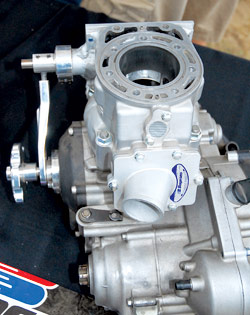
Pictured is a weird looking 2-stroke engine equipped with a lever not unlike those used to power a steam engine.

The lever is moved by a crankshaft eccentric to open and close an exhaust valve guillotine every stroke of the engine.

Boyeson claims this action delivers amazing, 4-stroke-like torque, incredible fuel economy and dramatically reduced emissions without direct injection.

Clearly, the patented concept was on display to attract OEM attention and a potential patent sale. Stay tuned!

Sportech Moves To New Facility in Elk River

Press Release –

Sportech Incorporated, a Minnesota homegrown thermoplastic manufacturing company located in Elk River, Minnesota, recently moved into their new 90,000 square-foot facility marking an incredible milestone in their ten-year history.

Known as a leader in the powersport industry for their thermoformed manufacturing techniques, Sportech is the supplier to the industry’s biggest and best original equipment manufacturers (OEMs) in the motorcycle, ATV, UTV and snowmobile markets.

The official move-in date was October 13, 2008, ten years to the day when Sportech first opened its doors in a modest 10,000 square-foot facility with just three employees.

Today, Sportech employs more than 100 employees and is known for its state-of-the-art, high volume, and large format vacuum forming capabilities and is one of the largest/highest volume polycarbonate and acrylic drape-forming companies in the world.

Sportech is a true Minnesota business success story. Founded by Chris Carlson of Elk River, along with his father Dallas Carlson, Sportech was born of a passion for motorsports and a simple product that provided a simple solution.

“Our first product was a plastic shield which kept snow from building up on older Polaris snowmobiles,” said Carlson. “My father and I went to Haydays which is big outdoor swap meet for snowmobilers with a bunch of them in the back of our pick-up. We sold every one of them.”

Since then Sportech has forged a path of growth and success by developing innovative solutions for many of the best powersports companies in the world. Along the way, Sportech has also built a reputation for integrity second to none.

“We are truly blessed to be working with the best in the business,” said Carlson. “Each of our business relationships is very special to us. We don’t take a partnership lightly, we want to be the company they can rely on to deliver solutions and value.”

The key to such success according to Carlson is an intimate understanding of the customer, both the manufacturer and the enthusiast.

“Almost everyone here (Sportech) is passionate about the industries we are involved in. That means we have a deep understanding of what the end customer is looking for. We take that to heart when working with a manufacturer as we design and innovate new products. That’s one of the biggest reason we continue to excel in this market.”

The new Sportech facility will dramatically increase manufacturing capacity as well as operational efficiency thanks to not only greater space, but improved work flow, expanded storage and improved communication and interaction between various departments.

Sportech’s success has not gone unnoticed. The company has been a two-time recipient of Minnesota Business Journal’s “Growth 50” award; Multiple recipient of Ehlert Powersports Business Magazine’s “Nifty 50” awards recognizing innovation in product design; Named one of the 100 Most Influential Companies in the powersports industry by Ehlert Powersports Business Magazine; and has been awarded key patents or has patents pending for several design innovations.

Cummins Power Generation Partners with ERX

Press Release –

With ground breaking and track creation nearing completion on the recently announced Extreme Motor Park (ERX) near Elk River, Minnesota, and cold temperatures in place, snowmaking has commenced with help from the newest ERX partner – Cummins Power Generation.

The power needs for air compressors, water pumps and fans guns, along with facility lighting are enormous; especially when snowmaking needs require immediate in-demand power for extended periods of time.

But thanks to Cummins Power Generation, an industry leader in power generation for over 80 years, those demands have been met with the best power solution available and the ERX track is currently being transformed into a world-class snocross track.

“Cummins has a tremendous amount of expertise in this area,” said Tom Smith, Sales Manager for Cummins Power in the Midwest. “We supply power for several world renowned ski-resorts throughout the world for their snow making efforts. We understand the tremendous power needs required for these types of applications and we know the power has to be there at a moments notice. When it comes to making snow you have to be ready when Mother Nature decides.”

But making snow is only part of the equation for Cummins Power according to Smith. “We (Cummins Power) are excited to be associated with a first rate motorsports facility like ERX. But aside from the passion for racing many of us share at Cummins, it’s refreshing to partner with a team such as ERX that has such strong family and community values. It’s a reflection of the same values Cummins Power and its employees share so it’s a great fit.”

Located on the outskirts of the Minneapolis/St. Paul metro area in the city of Elk River, ERX is a professionally designed and staffed year-round motorsports facility.

The park will feature racing, open practice, club events, demos and more for snowmobiles, motorcycles, ATVs and UTVs year-round.

More importantly ERX will focus on grass roots racing, giving first timers and recreational riders a chance to experience and enjoy their preferred motorsports hobby with an emphasis on family fun In addition to providing power for snow making equipment, Cummins Power will also be the driving force during events, powering lighting equipment, vendor tents, public address systems and more.

Six events are currently slated for ERX this winter, with more on-deck as well as a summer schedule to be announced later this winter. ERX will also be available for private uses such as factory team testing, special dealer demo events, test rides, training and safety classes, swap meets, club functions and more.

Details including racing classes, rules and directions to ERX can be found on the new ERX website: www.erxmotorpark.com

Kick-Off to ‘Get Ready to Go Snowmobiling Week’

Press Release –

$3 Million Goes Into OntarioTrail Improvements

A taste of winter has arrived in many parts of the province and the Ontario Federation of Snowmobile Clubs (OFSC) officially kicks off its 2008/09 season with Get Ready to Go Snowmobiling Week, November 24 – 30. However, no OFSC trails are open for riding yet and the OFSC warns riders that conditions are not safe for sledding this week.

The big news for Get Ready to Go Snowmobiling Week is that, thanks to support from the McGuinty Government, the OFSC is unveiling almost $3 million of trail and infrastructure improvements this season.

These upgrades will significantly enhance the snowmobiling tourism experience and make it even easier and more enjoyable to go ride in Ontario.

The $3M trail improvements are very timely, because the OFSC Go Snowmobiling Campaign and Ontario’s Go Ride promotion are poised to increase ridership this winter.

Not only will Ontarians do more riding here, but more American riders are also anticipated, due to post-election optimism, lower fuel costs and the return of more attractive exchange rates.

The OFSC notes that snowmobiling typically holds its own through economic downturns as evidenced by strong participation rates and permit sales in previous periods of uncertainty.

Get Ready to Go Snowmobiling Week heralds another good news story. Coming off a banner season last winter, snowmobiling is poised for a repeat, with permits fees unchanged, fuel prices falling and sled manufacturers offering many attractive incentives to buy snowmobiles.

Meanwhile, winter forecasts are also encouraging, predicting good snow conditions in most traditional Ontario snowbelt areas.

As its name implies, Get Ready to Go Snowmobiling Week is the cue for sledders to start making plans and preparing sleds and gear. Sled dealers and snowmobile clubs across Ontario are celebrating Get Ready to Go Snowmobiling Week with open houses and other special events.

Get Ready to Go Snowmobiling Week also marks the last week for purchasing full season Snowmobile Trail Permits at the pre-December 1st fee of $180.

The OFSC invites all Ontarians to connect with family, friends and nature by going snowmobiling this winter.

Get Ready to Go Snowmobiling Week is the ideal time to visit these key web sites to learn more and start planning your season: ofcs.on.ca and gorideinontario.ca.

The Ontario Federation of Snowmobile Clubs is dedicated to providing strong leadership and support to member clubs and volunteers, to establishing and maintaining quality snowmobile trails which are used in a safe and environmentally responsible manner, and to furthering the enjoyment of organized snowmobiling.

New ‘Team’ Class Added For Red Lake I-500

Press Release –

Now you can experience the thrill of competing in the legendary I-500, but at a fraction of the cost and with your friends.

It’s the result of a new “Team 600” class, which joins 11 “individual” class options for the 2009 Red Lake I-500 (Jan. 16-18) at the Seven Clans Casino in Thief River Falls, Minnesota.

Teams may consist of two or three members, with one person tackling each day.

The team can opt to use one snowmobile for the entire event or a different sled for each day. Eligible snowmobiles must be no larger than 600cc two-stroke or 1050cc four-stroke, of any model year.

“The Team 600 class gives riders a chance to be a part of this historic race without the full affect of the physical demands that come with racing 500 miles over three days,” said Pat Mach, U.S.C.C President. “Being able to share the race expenses among two or three riders makes this a terrific opportunity for friends or families to get a team together and experience the “500” firsthand!”

The Team Class concept was tested at the 2008 I-500 when members of the snowmobile media competed as 3-person teams aboard identically prepared Arctic Cat F5s, with each member riding one of the three days.

“They all agreed that racing the I-500 as a team was one of the most satisfying and enjoyable experiences they’ve ever had,” said U.S.C.C. President, Pat Mach. “Riding as fast as they could one day, then helping out and watching their buddies the other days proved to be an awesome way to participate in this classic event.”

Additional information can be found at www.usccracing.com.

Globalstar Announces New Low Price for SPOT

Press Release –

$50 instant rebate makes personal safety more widely available to outdoor enthusiasts, adventurers and winter travelers

Globalstar Canada Satellite Co., a leading provider of satellite voice and data services, announced that effective today, the SPOT Satellite Messenger is now available at a new low price of $119.99 after a $50 instant rebate.

The world’s first GPS-enabled personal satellite tracker, SPOT has helped in over 120 rescues around the world since it was introduced one year ago.

Combining reliable commercial satellite and GPS location technologies, SPOT is a lifesaving and affordable personal safety device, designed to provide users with a vital line of communication to friends, family and emergency services, independently of cellular coverage.

“With the start of winter just a few short weeks away, SPOT is the only personal safety device of its kind that provides peace-of-mind for travelers and outdoor adventurers,” said Jim Mandala, General Manager, Globalstar Canada. “Customers are demanding more reliable, affordable and functional GPS-enabled tracking devices, and we are pleased to be able to offer SPOT at a price that is more affordable than ever – and just in time for the start of the winter season.”

SPOT enables users, based on varying levels of need, to send messages to friends, family, or emergency responders, and to visually track the location of the SPOT Satellite Messenger through the following features:

– Alert 9-1-1 notifies emergency call center of GPS location coordinates;
– Ask for Help sends a request for help to friends and family;
– Check-In lets contacts know where you are and your status;
– Track Progress sends and saves your location and allows contacts to track your progress using Google Maps.

Weighing just more than seven ounces and well-priced for the consumer market, the SPOT Satellite Messenger is an ideal personal safety device for the growing market of outdoor enthusiasts, adventurers and remote workers in Canada. For more information on SPOT visit www.findmespot.com.

Price and Availability

After a $50 rebate, SPOT is available at $119.99 and a one year service subscription starts at $99.99. SPOT is available a major consumer electronic and specialty outdoor retailers across Canada. For more information including a dealer locator, visit www.findmespot.com.

About Globalstar Canada

Globalstar (NASDAQ:GSAT), offers satellite voice and data services to commercial and recreational users in more than 120 countries around the world . The Company’s products include mobile and fixed satellite telephones, simplex and duplex satellite data modems and flexible service packages. Many land based and maritime industries benefit from Globalstar with increased productivity from remote areas beyond cellular and landline service. Global customer segments include: oil and gas, government, mining, forestry, commercial fishing, utilities, military, transportation, heavy construction, emergency preparedness, and business continuity as well as individual recreational users. Globalstar data solutions are ideal for various asset and personal tracking, data monitoring and SCADA applications. For more information, visit www.findmespot.com.

Arctic Cat All About Speed

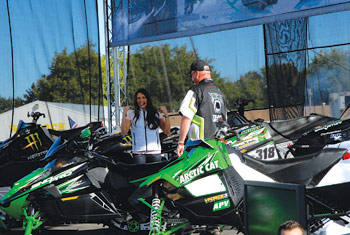
Arctic Cat was all about speed at Hay Days. A full-on rock stage held three sleds Cat was hanging “World’s Fastest” handles on.

No disagreement here. The 2009 Arctic Cat Z-1 Turbo is crazy fast – likely the fastest production sled ever built.

Not surprisingly, it took top billing at AC’s Saturday morning unveil. Next was the new, limited build HCR M-8 rooster. HCR stands for Hill Climb Racer and, whether it’s the fastest in that discipline or not, it looked seriously light, trick and powerful.

Finally, the limited build 600 Sno Pro was unveiled to roars of applause. The new Sno-X and XC weapon from AC is refined again for 2009 boasting a complete engine re-working to fulfill Cat’s ongoing quest for more power.

The entire “World’s Fastest” theme was a home run with the crowd and demonstrated a momentum shift is underway in Thief River Falls.

MOTORHEAD: Mileage Myths Exploded

0

By: Motorhead Mark Lester

Over the years we’ve been on the receiving end of many diverse requests from Supertrax readers. It used to be all about top speed. Later came the weight issue.

It still lingers and many continue to ask us what we think is the lightest snowmobile. Times are changing and, recently, your questions have moved in an entirely different direction. Now, the query du jour is: “Which sled gets the best gas mileage?”

Believe me, we listen very carefully to what you’re talking about. This year, everyone is talking about snowmobile fuel economy and because of this critical interest, this issue of Supertrax features “Mileage Champs” – a story on ‘09 sleds delivering impressive fuel economy.

We’ve made painstaking efforts to get you meaningful data on this topic. However, we’re not going to back away from this indisputable reality – snowmobile mileage is a moving target. However, it is reasonable to expect mpg info from us. We’re the experts on the sleds you want to buy. We ride them first, we ride them thousands of klicks in-season and we attempt to take every sled we report on, to ten-tenths of its potential – even if you never will.

This summer we had an intrigiuing opportunity to witness an all-terrain vehicle mpg test performed by our friends at Dirt Trax Television (the same Crew who produce North America’s top snowmobile TV Show, Snowtrax Television). What we learned from the Dirt Trax guys is this: The latest EPA sleds are only a whisker away from the latest ATVs when mileage is the issue. Got your attention now?

Dirt Trax took four new Sport Utility ATVs – a 300, a 650, an 800 and a 1000 on a 50 mile (80 kilometer) tour. They intentionally used pavement to eliminate any variations caused by wheelspin. Sure, ATVs are not used on roads but the Dirt Trax guys were intent on keeping the playing field level – something it’s impossible to do with snowmobiles.

The results generated were enlightening. First, the most powerful ATVs produce less than half the horsepower of the most fuel-efficient snowmobiles. Second, all the ATVs were 4-strokes.

Three of them had EFI and one was a carbureted model (the 300). Finally, the test data was accumulated with the operators paying strict attention to a 40 mph top speed with absolutely no full throttle pulls, period.

They were told to drive like fuel is expensive… hmm? Without stealing their thunder, the results of the Dirt Trax test were stunning. The most fuel efficient ATV in the test generated just over 38 mpg (US gal); the least carded 30.5 mpg.

Rewind to last winter and the arrival of the first direct injected Ski-Doo E-Tec 2-stroke. The 600E-Tec produces 120hp and moves a vehicle weighing between 400 and 450 pounds. After we completed the programmed-in break-in cycle we began scrutinizing gas mileage. At first we thought we were doing something wrong.

The sled carded one tank at 26 mpg. Admittedly it was an easy trail ride but I can assure you, there were some full pulls and 40 mph speeds were not strictly adhered to. Yamaha’s Vector has been a mpg champ for two seasons around here and we’ve seen 23 mpg under similar conditions.

Lets get some perspective. Snowmobiles produce a lot more rolling resistance than ATVs. Snow is an ever-changing medium that always produces slippage and most certainly requires significant power to overcome the friction of pushing skis and dragging rubber through it. When we calculate our mileage tallies, we use real world riding simply because there are no “perfect” conditions like pavement to run sleds on. However, when we talk about maximum mileage numbers, we don’t run WOT down Kevlar Lake, either.

Here’s the twist. Lets say we took those big displacement ATVs producing 60-70hp and ran them harder than the Dirt Trax test. Would their mpg drop? Certainly it would. Lets speculate a drop of 25 percent as a result of more aggressive throttle plying with some loose soil and mud mixed in. It could mean some 120hp sleds can deliver near-identical mileage.

Okay, we’ve made assumptions here to shed light on what we’re currently living with. Today’s modern, EPA certified, 110-120hp sleds are the mileage champs of the sno-mo-biz. However, those individuals we’ve heard talking negatively about snowmobile fuel economy need to look closely at the rest of the powersports industry for perspective.

We witnessed a strange twist while looking over the Dirt Trax guy’s shoulders. The 300cc 4-wheeler delivered better mileage – but not much better, considering its horsepower variance of more than 100 percent compared to the bigger ATVs. With sleds, this effect works backwards. Our 600 class EPA emission champs deliver better fuel economy than sleds producing about half their power.

Sure, ATVs still get better mileage than sleds, however, you don’t need a PhD to quantify the differences in power and the uncooperative surface sleds operate on.

INSIDE TRAX: 20 Years Moves Fast!

0

By: Kent Lester

Leafing through back issues, doing research on 20 years of Supertrax was a lot of fun. I guess it’s true, time really does fly when you’re having fun – and we’ve had plenty over the past two decades.

It was great to flip pages from the early 90s and observe the different trends that have developed in snowmobiling – and, particularly, in snowmobiles.

How much has the modern snowmobile changed in the last 20 years? Plenty! Although the Supertrax era pretty much began after the years of independent front suspension, there have been other dramatic changes and they’ve evolved in cycles, all generated by your demands.

If you look back into the 80s, you’ll discover the biggest focus then was on getting all snowmobiles to adopt some form of IFS. From 1979, when the first production Polaris Indy was introduced, the industry never looked back.

Yamaha developed aircrafty struts, Arctic Cat began offering wishbone variations and Ski-Doo worked on them all, gaining its most consistent results from trailing arms.

By the time the first issue of Supertrax landed on newsstands, the focus was on suspension but not as it related to ride quality.

It was believed that independent front ends delivered more precise handling on snow and gave sleds that “race car” accuracy riders had been seeking so long. It turned out to be true but ride compliance was a moving target the manufacturers had barely identified.

When it came to engines, 2-strokes reigned supreme and 4-stroke snowmobiles simply didn’t exist. Held in greatest awe were the Polaris 600 and 650 triples – snowmobile engines with legendary smoothness and an exhaust sound Supertrax dubbed “The National Anthem of Snowmobiling”.

The manufacturers had barely bought into large displacement engines at that time. The 650 Wildcat twin was considered to be a massive howitzer of an engine and a 700 was unimaginable. For a long time, Ski-Doo and Yamaha were determined to squeeze big HP numbers out of engines with less than 600ccs.

Throughout the 90s, engine displacements increased and technical developments like reed valve induction and flatslide carbs were adopted by all the OEMs.

2-stroke electronic fuel injection was advanced by Polaris and Arctic Cat and, by the end of the decade, every manufacturer offered some variation of a 3-cylinder mill. Engine displacement standards had climbed into the 800cc range and Arctic Cat had delivered a 900cc triple in the Thundercat.

Sometime in the early 1990s discussion turned to suspension and ride quality. Long travel became a keyword and inches of suspension movement started to become the status quo for sales appeal. In the mid-1990’s Polaris jumped into the fray with a sled called the XLT.

With suspension travel in the 10-inch range and a smooth, small displacement piston port triple, it had the comfort and sizzle consumers wanted and its price was absolutely a bargain. After the XLT, every OEM was flat-out forced to build sleds with long travel suspensions.

By the end of the decade 9-inches in the front and ten in the rear was the industry standard. Shock packages were a critical selling point and adjustability (even though most consumers never took advantage of it) was a headline design feature.

Also in the 90s, the issue of snowmobile weight began to gain momentum. Because of the 3-cylinder engine phenomenon, chassis weight had been climbing and the type of riding snowmobilers prioritized, riding on groomed trails, didn’t rely on lightness so much as suspension compliance.

Actually, two factors evolved at the same time to make snowmobiles different than they’d been in the past. The rise of snocross bred a new group of younger riders who liked the challenge of rough trail or ditch riding and these enthusiasts began demanding lighter sleds.

These same riders began to see that long travel suspension, weight and, along with those two, engine torque, made a snowmobile ride bumps like a good motocross bike.

The rest is history. Sleds began paring away every spare ounce of mass, engines grew in displacement and offered big-inch twin cylinder mills with enormous torque output and suspension travel numbers increased beyond imagination. Triples were passé, electronics took over and the modern age began.

Next came 4-strokes and rider forward ergonomics. In 2003, Yamaha rocked the snowmobiling world with the RX-1. Prior to this, Arctic Cat had shown a 60-horsepower version of a 4-stroke – actually a very good sled.

But the RX-1 showed a determined commitment to high performance 4-stroke sleds and Yamaha claimed all its snowmobiles would be 4-strokes within the next five years.

The same year, Ski-Doo ventured the new REV, a sled so radical in design it has completely changed the way snowmobiles are designed and ridden.

Was that a busy 20 years or what?