Home Blog Page 342

January Is Environment Month in Ontario

Press Release –

Across Ontario, snowmobilers have been doing their part to keep nature beautiful for more than 40 years.

This January, the Ontario Federation of Snowmobile Clubs (OFSC) celebrates these achievements during Provincial Snowmobiling Environment Month and reminds snowmobilers: to stay on OFSC trails; to leave tracks not trash; to avoid noisy after market mufflers; and to maintain sleds at peak operating efficiency.

Environment month celebrates snowmobiling’s evolution to cleaner and more advanced technology. Today’s snowmobiles run more efficiently, effectively and quieter than ever before, with 98% fewer hydrocarbons and 94% less sound than older sleds.

Significantly reduced emissions, virtual elimination of smoke and smell, and much greater fuel efficiency herald a good news story for the future of snowmobiling. Overall, snowmobiles account for only a small fraction of all the motor fuel burned annually in Ontario.

Provincial Snowmobiling Environment Month also highlights that the presence of OFSC snowmobiling is contained, minimal and seasonal. While Ontario’s total land area is just over 900,000 square kilometres, the surface footprint of all OFSC snowmobile trails is approximately 122 square kilometres, about the same as one good-sized town.

By choosing to ride on clearly defined and organized trails that take up less than .0025% of our overall landmass, OFSC snowmobilers substantially reduce interaction with wildlife and plants. In addition, trail riding occurs with a blanket of snow protecting the earth, thereby further mitigating any impact. After the snow melts, nature flourishes again from spring to fall on OFSC trails.

Provincial Snowmobiling Environment Month is also a celebration of many OFSC stewardship accomplishments. Each OFSC snowmobiler contributes one dollar from the fee for a Snowmobile Trail Permit to the OFSC Environment Fund.

The OFSC has invested more than $1.35 million from this fund to underwrite worthy environment projects such as fuel containment systems, erosion control, and reseeding and replanting.

Recent Environment Fund initiatives also include sponsoring a University of Waterloo engineering team for the Society of Automotive Engineers (SAE) Clean Snowmobile Challenge.

This annual international competition helps create new technology to further reduce exhaust emissions and sound.

Meanwhile, the OFSC is also partnering with the internationally recognized School of Environmental and Natural Resource Sciences (SENRS) at Fleming College (Peterborough, Lindsay, Cobourg & Haliburton) to work strategically in advancing environmental and natural resources stewardship programs and initiatives.

The OFSC is committed to proactive leadership and support for snowmobiling and snowmobile trails, to conserve, protect and appreciate the environment in a responsible, long-term sustainable way, which enhances the health, enjoyment and prosperity of Ontarians, by working with stakeholders in many ways, including effective planning, education, programs and environmental projects.
Best Athletes in the World Set to be at Canterbury

Press Release –

Round 3 of the AMSOIL Championship Snocross Series Set for Canterbury Park January 9-11; Top X-Games Snocross Racers and Freestyle Athletes to Compete

The top professional snocross racers on the planet, as well as the leading freestyle athletes anywhere will invade Canterbury Park in Shakopee, Minnesota for Round 3 of the AMSOIL Championship Snocross Series.

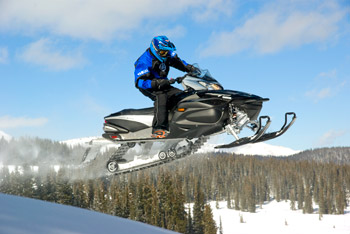
More than 15,000 fans are expected to witness the world’s best snowmobile riders compete side-by-side for more than $250,000 on a racetrack littered with huge jumps and insane terrain. Racers will fly more than 80-feet in excess of two-stories high as they negotiate a course laid out in front of the heated Canterbury Park venue.

Winter X Games Champions including Minnesota’s own Tucker Hibbert and Levi LaVallee as well as freestyle king Chris Burandt will be there, giving area fans one of the few opportunities of the year to see these incredible riders in person.

The weekend heats up fast Friday night at 7:00pm with a FREE Monster Energy Slednecks Invasion Tour freestyle showcase. The top freestyle athletes in the world including Chris Burandt and Paul Thacker will perform some of the most insane tricks ever seen on a snowmobile including a back-flip!

Riders will launch their snowmobiles from two freestyle ramps to a backdrop of infused rock and free swag for the fans. Joining them will be the biggest names in snocross racing for an evening of hospitality, autographs and family fun.

Competitive juices flow early Saturday morning with support class racing, culminating with the Main Event from 4:00pm to 7:30pm. This all-out showcase of the top Pro and Semi-Pro riders anywhere will be bar to bar non-stop action, with Pro and Semi-Pro finals running back to back.

During the action, the heated Canterbury Park facility will host displays from leading snowmobile manufacturers and aftermarket suppliers along with food and beverages. There’s also free snowmobile demo rides or the kids with a chance for one lucky participant to win a new Arctic Cat kids snowmobile.

Capping off the weekend will be Sunday support class racing, with local racers competing on a national track. Racing gets underway at 9:00am both Saturday and Sunday, but race fans will want to be sure they are in the stands 4:00pm Saturday for the Main Event.

Advance weekend passes are just $30 with kids 12 and under FREE! Visits www.isocracing.com for more information and tickets.

Arctic Cat Weight Correction in Supertrax

0

Seems Supertrax messed up the claimed manufacturer’s weights for the Crossfire 800 and 1000 in our 4-stroke comparison article last issue.

In our Crossover Power & Weight Data Chart on page 36 we indicated the dry weights were 545 and 534 lbs respectively for the CF1000 and CF800 with 141-inch tracks.

According to info sent to us by Arctic Cat this week, both sleds are considerable lighter.

The standard issue Crossfire 800 141-incher weighs in at a claimed 471 lbs and the 1000 at 497, dry.

The Sno-Pro versions of both these sleds are even lighter.

The same adjustment goes for the Crossover Footprints Chart on the same page. The footprint for both these sleds will be much lighter than we published for comparison sake in the article.

The Cat 800’s footprint is down from .631 pounds per square inch to .556 and the 1000 comes in at .587 lbs/sq-in.

These are considerable weight changes and make a difference when comparing these two Crossfires to 2-stroke Crossover sleds like the Ski-Doo Renegade 800R and the Polaris 800 Switchback.

Fortunately, the article was about 4-strokes and not a direct comparo of these 2-stroke sleds.

Something Very New From Yamaha

0

Here’s the deal. We’re sworn to secrecy… sort of. Actually, we can tell you we rode a completely new Yamaha over the Christmas break but as of this writing we cannot publish any pictures or disclose technical details… yeah right, if we had any.

The reason: We didn’t really see it – even though we rode it and the staff present for our 140 mile tour patently refused to answer any specific questions about it, beyond verifying it was painted red.

Of course those who follow Yamaha’s product carefully will no doubt be able to fill in some blanks, just as we did.

While we came away impressed and have pretty solid hunches we know what’s going on here, nothing is etched in stone because the Yamaha brain-trust will simply deny this ever happened.
Our impressions are pretty significant after a minus 15C all-day pull to Whitney, Ontario on some of the sweetest, freshly groomed, table-top smooth trails we’ve seen in years.

The sled steers easier and offers more intuitive feedback through the handlebars than any snowmobile, particularly any Yamaha, we’ve ridden to date.

Inside ski-lift, something Yamahas have struggled with, is markedly decreased and we suspect what looked like a new ski profile combined with the aforementioned light and responsive steering feel are reducing this unwanted trait in a pretty dramatic way.

The sled lays down power in the typical Yamaha 4-stroke linear way but there’s something different here. The engine is buttery… no, velvety smooth beyond any 4-stroke engine we’ve plied to date. How many holes does it have? Dunno for sure… we think maybe four.

Rider ergonomics are much improved with a taller, more upright rider-forward seating perch that immediately improved comfort and control allowing the pilot to easily perform gymnastics in twisties or make sitting-to-standing transitions through trail junk.

Ride quality is consistent with what Yamaha has become legendary for – exceptional. That’s because the monoshock skid looks pretty much the same as what we’ve come to know and love here at Supertrax.

Trail trash, craters, and jigglers are erased completely with this set-up. We also felt traction – particularly when exiting turns or pulling away from rest was better than any previous 121-inch Yamaha. Hmm, wonder why?

We’ll have more on this new Yamaha later this month – including some pics we were allowed to take but had to surrender when the Yama-staffers demanded a body cavity search after the ride. Thankfully, after they found them they didn’t want to keep them. We will put them up for your viewing pleasure soon.

Yes, most definitely, stay tuned.

YAMAHA RS VECTOR: Comfort + Mileage = Big Smiles

0

From The Pages of Go Snowmobiling Magazine

Last year, Yamaha graduated the Vector to the Apex rider-forward platform and increased the appeal of its most popular model (up to that point).

Despite the upgrade, the Vector was still upstaged by its newest sibling, the razor-edged Nytro. This is a shame because for Ontario long distance trail riders, the Vector was and still is a much better choice. Why? It’s a combination of comfort, ride and great mileage.

Although the Nytro scores high in these categories, the Vector exceeds – and does it all for a lower sticker price.

Only two variations of the 121-inch Vector are available for 2009: The baseline Vector equipped with steel body gas shocks and the slicker painted GT with GYT-R piggybacks up front.

Surprisingly, both sleds use the same shocks and spring rates in the rear. This is all good because the Vector’s dial-on-the-tunnel adjustable monoshock skidframe is impeccable.

It’s really the only skidframe in this class that comes within a hair’s breadth of matching Arctic Cat’s sliding arm setup for all round ride compliance and you can instantly tune it to your liking, if you choose to.

Both models come with electric start and reverse – boiler plate features in this category – and comparable digital/analog gauge packages.

The Vector’s 3-cylinder 4-stroke is Yamaha’s only carbureted snowmobile engine and it’s a good one, making 120 honest horsepower and sending impressive torque through its clutches down to its 1.25-inch RipSaw track.

We’ve never been disappointed with this sled’s power output. Is there a downside to carburetors? In this case, we don’t think so.

Our experience with the Vector engine is that it starts and idles beautifully even in frigid temperatures and has a surprisingly linear and predictable power delivery.

We have yet to hear a pop or sputter as we’ve spooled up the clutches and the engine always seems more than willing to produce an even temperament whether accelerating from launch or when summoned at mid-range.

Gas mileage is among the top sleds we’ve rated at Supertrax and last issue’s MPG Masters comparo put the carbureted Vector among the best in this category, exceeded only by the Ski-Doo 600 E-TEC.

Here’s a consideration: If you’re planning on saddlebagging, the 121-inch Vector may lack the necessary space to comfortably accommodate all your gear.

Its in-body storage is minimal and valuable seat space can be taken up by your add-on tied-down luggage. We’d suggest spending a bit more for the 136-inch Vector LTX.

With the longer tunnel and track you’ll gain even more ride compliance and you’ll have bonus space at the back of the tunnel for loading bags and gear.

We can’t explain it, but we think the LTX, with its longer track, looks way better proportioned, too.

The Vector offers great comfort and enough amenities to fully satisfy Ontario big-milers this winter.

Click here for specs and details!

Ride Report: Arctic Cat Crossfire 600 141

0

By: Kent Lester

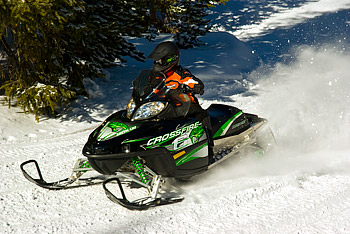
We were skeptical about the trail riding proficiency of the 2009 Crossfire with its longer 141-inch track.

Since we do most of our testing on trails, we really don’t like the idea of dragging extra inches of track around tight corners on groomed trails. We’ve put a couple hundred miles on it now.

We first rode the sled in Colorado last March and were impressed with its crisp running EFI 600 but, because of conditions there, couldn’t tell if adding the 141-incher had produced any negative effect on handling.

Although this isn’t the most sophisticated 600 2-stroke out there (it’s not an SDI or DFI and only uses a pipe sensor to control emissions), we felt it worked very nicely in the lightweight Crossfire chassis and delivered decent power with almost no fuss.

At warm-up there’s considerably more smoke from the exhaust than the E-TEC, though.

Our press 600 was set up by Birch Point Cats in Bobcaygeon, Ontario, and even with a fully studded track, we were shocked at how well the sled handles on hard packed snow.

Yup, it’s a 15-wide track, so even though the extra length only adds about another 2.5 inches on the ground, you’d expect there’s a fair bit of resistance from the studs and extra lug surface and track width (compared to the 14-inch wide ’09 CF-R). Not so.

We didn’t notice one iota of difference in the way this sled handles even compared to last year’s 136 Crossfire – and believe us, this thing can float large in deep powder!

The new 141 Crossfire makes a strong case for OEMs fine tuning sleds they already have in production. This one is a sweet ride and, frankly, has surprised us all.

Click here for specs and details on the 600 Crossfire

EXPERIENCE EASTERN QUÉBEC SNOWMOBILE TRAILS

0

With loads of powder-perfect snow, extraordinary views, an immense blue sky and 6000 km (3700 mi.) of wide, well-groomed trails, Québec maritime in winter is a snowmobiler’s dream.

The region offer all the conveniences for a great stay; a host of accommodation choices from luxury hotels to woodsy chalets, and great food from gourmet dinning to great local fare.

You’ll always find fuel and services nearby, and you’ll be charmed by the warm welcome of the local people.

Quebec maritime is a vast maritime territory in Eastern Québec, crisscrossed by great snowmobile trails on both shores of the St. Lawrence River.

It encompasses the regions of Gaspésie, Bas-Saint-Laurent and Côte-Nord, from Tadoussac to Blanc-Sablon and on to the Labrador coast.

You can explore this region via several loop rides as The Great Gaspé Peninsula Tour. This ride between sea and mountains will take you around the stunning, world-renowned region of Gaspésie.

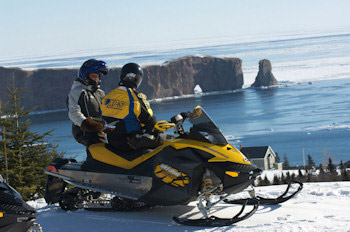
Explore the Chic-Choc Mountains, ride along the St. Lawrence River and, last but not least, admire famous Percé Rock, which looks even more extraordinary imprisoned in ice.

With over 2000 km (1200 mi.) of trails, the Gaspésie region is beyond your wildest dreams!

Enjoy the best of both worlds with The St. Lawrence Tour! Ride part of the Gaspé Peninsula Tour (on the south shore) and also explore the north shore of the St. Lawrence River (Manicouagan region).

Crossing the icy waters of the St. Lawrence by ferry with your snowmobile is an extraordinary and unusual experience.

However, crossing a 700-feet long and 90-feet high bridge built only for snowmobiles is no less exciting!

Fun is waiting for you. Start your trip today, visit www.bonjourquebec.com/snowmobile

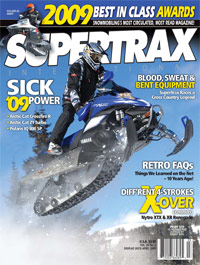
LATEST ISSUE LANDING!

The latest issue of SUPERTRAX (Volume 20, Number 3) is landing on newsstands soon!

This issue features the second annual BEST IN CLASS AWARDS!

You’ll also get a look at 3 Big-Inch players and read about one of the most grueling cross-country races on snow.

Plus the Nytro XTX and Renegade XR go head-to-head!

Click here to subscribe!

Getting Started On The Season

By: Bruce Robinson

Winter started for me when my dealer called to say that my new sled was ready for pickup. I love the smell of new sleds, new trucks, new accessories… you know, that fresh-off-the-assembly-line aroma full of carcinogenic compounds!

I brought my sled home and set it on the ‘lift’. I set the light just right so that it looked like a work of art poised ready for action. Then every time one of my friends dropped in, we visited the garage with a beverage and planned our winter’s escapades.

Although the ladies pretend to be above all of this ‘boys toys’ talk, don’t think for a minute they weren’t just as excited about winter as we are!

Liz and I live in the heart of snowmobiling country, Eastern Ontario style. Our club promotes family riding and, as a result, many couples are avid snowmobilers and we enjoy each other’s company.

We know about all those wonderful snowmobile excursions to distant locations that advertise ‘snowmobile heaven’ with the world’s best trails. Believe me, those trips are lots of fun and it’s great seeing new scenery, new trails, and make new friends.

But I want to spend a couple of minutes talking about the average ride for the average rider… what I call the meat and potatoes of snowmobiling!

For instance, Friday nights this winter I will rush home from work. One of our friends will likely have called to get together for a short run. We may sled to our favorite restaurant, then return the long way home just to take in a few more kilometers of our familiar trail system.

Hopefully, we will have crisp night air and a star filled sky, and we can possibly catch a glimpse of a rabbit darting across our path as we glide along effortlessly, knowing exactly every twist and turn in the trail like the back of our hand. But it never gets stale, does it?

What about those Sunday excursions where we gather six or eight of us and head for a neighboring club’s trails? We explore off the beaten track, leaving the TOP trails far behind to ride local trails through the back fields and bushes, maybe even to catch a glimpse of a deer or wild turkey.

We will stop now and again to compare notes: “I believe they’ve rerouted this trail since the last time I was here!” or “That old sugar shack is almost fallen down now!” Observations only folks who are very familiar with the trail can make.

Of course, any Sunday excursion is not complete without stopping by the clubhouse to see who’s there and getting a bowl of their famous chili. We arrive back just before dark and gather at one of our homes to order in a pizza, or maybe the slow cooker has worked its magic all day while we were gone.

For thousands of Ontario sledders, this is recreational riding, and it’s what snowmobiling’s all about. Many have never been out of their own county, let alone to the other end of the province.

Long overnight trips are certainly the mainstay of snowmobile tourism, but the miles of smiles that local riding provides makes up the bulk of kilometers ridden each year in Ontario. Local clubs depend on local riders to buy the permits, attend the events, and to lend a hand.

Without those local riders, a club is just an empty legal shell. It takes we locals to generate the passion, foresight, determination, and manpower to continue to keep our club trails top notch.

Now don’t get me wrong, the OFSC TOP Trail system is the backbone of organized snowmobiling in Ontario, and I love those connected trails that take us from one region to the next as much as the next guy. I also believe that the TOP system needs to have grooming and maintenance priority.

But in the grand scheme of things, let’s not forget where the bulk of the local riding happens… on those less traveled, backcountry routes that are the hidden treasures of OFSC trails.

This winter, I will probably meet many of you as Liz and I tour across the province on the TOP trail system. But we also look forward to our local rides with friends and family, because riding at h ome is a whole lot of fun too! Until next time, keep your skis on the snow.

Weather Obsession

By: Mark Lester

I have to confess something. Anytime after the 15th of November I get obsessive-compulsive about the weather.

I’m constantly checking my sources for impending storms, cold fronts, moisture laden low pressure areas sweeping north from the southern US, all in an effort to glean potential snowfall information on my fave riding areas.

I’m not alone in this quest. I’ve had heart-to-heart conversations with other snowmobilers who also admit to similar tendencies. In more than 30 years of snowmobiling, my obsession with winter weather has not ebbed; actually, it has increased. Thankfully, therapy has become easier to access.

Complicating my condition is this: I actually experience weird head rushes (not chemically induced) every fall. Without warning, my mind goes to a place I love to ride. This is weird, yet enjoyable.

It’s not quite like I’m hallucinating, actually, it’s more like I’m snow-lucinating. As the calendar moves deeper into the year, this crazy passion for getting out and snowmobiling floods my synapses.

After all these years I still get excited about winter and that first snowfall. My best friend, wife Barb, capsules it this way: “You’re like a kid waiting for Christmas”.

Is there a cure? Not likely. However, as I said, treatment is available. The internet offers effective relief delivering updated weather information on a minute-by-minute scale.

Is there anything better than logging onto real-time weather radar at weatheroffice.ec.gc.ca? I think not! This site not only delivers great hourly forecasts, you can actually watch a storm or squall dumping snow on your trails.

This is superb therapy in my books! Note: If the POP number (probability of precipitation) goes above 60 percent, load your sled; above 70 percent, put your helmet on. Conversely, if POP drops below 50 percent, don’t bother topping up your injector oil.

There are other great sources for trail and weather info you should try this winter. How about the OFSC’s own site: ofsc.on.org – and then click through to Trail Reports?

This site gets ji-normous traffic and is particularly useful when planning a tour or multi-day trip. Generally, the OFSC site delivers current and accurate trail conditions, dead honest, if not slightly conservative in its ratings.

The OFSC’s Trail Conditions listings generate impressive web traffic, proving an increasing number of you are in need of trail condition rehab.

An interesting twist on the weather/trail conditions reporting concept comes from OFSC media sponsor, Skywords. Skywords is a syndicated radio broadcast producing accurate daily trail condition reports using its own network of OFSC reporters.

It’s a slick program aimed at delivering concise trail information to snowmobilers right up to and including when they arrive at the trailhead. Getting trail updates from the radio lets you continue annoying others with your weather/trail condition obsession while traveling.

Obviously, you can’t use your Blackberry driving so Skywords keeps trail data flowing while you’re driving, reducing the possibility of any sensible dialogue in the truck en route to your riding destination. Stations carrying Skywords Trail reports are listed in this issue of Go Snowmobiling Magazine. Try it, you’ll feel better.

Another great source for weather and trail conditions is weathernetwork.com. I personally enjoy this site’s 14-day outlook, using it to effectively calm anxiety during a mid-winter mild spell. There’s nothing more soothing than following the weather graph two weeks out as it predicts increasing cold and more snow. Think of it as long-range therapy.

While you’re hitting the web for weather info, you should bookmark accuweather.com too. There’s lots of forecast info here and a nice, easy-to-read long range forecast going out 15 days ahead. This site also offers some editorializing on current conditions, making for interesting reading when you’re suffering from low POP anxiety.

Face it, snowmobilers are weather addicts. This winter, learn how to manage the urge.