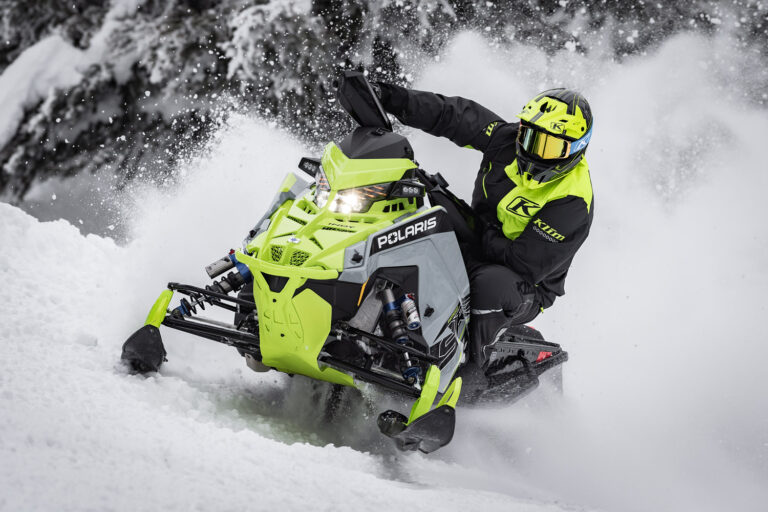
You asked and we’ve got answers in this informative MXZ X-RS 850 Turbo R Competition Package Virtual Hangout!
Luke sits down with Ski-Doo’s Global Product Manager, Robin Martel and Marie Eve Cyr, Product Specialist for an informative discussion covering all the nitty-gritty details of the new MXZ X-RS 850 Turbo R Competition Package with SHOT. In their discussion they cover the performance specs of the engine, details in turbo design and review the advantages of the new Water Injection System.
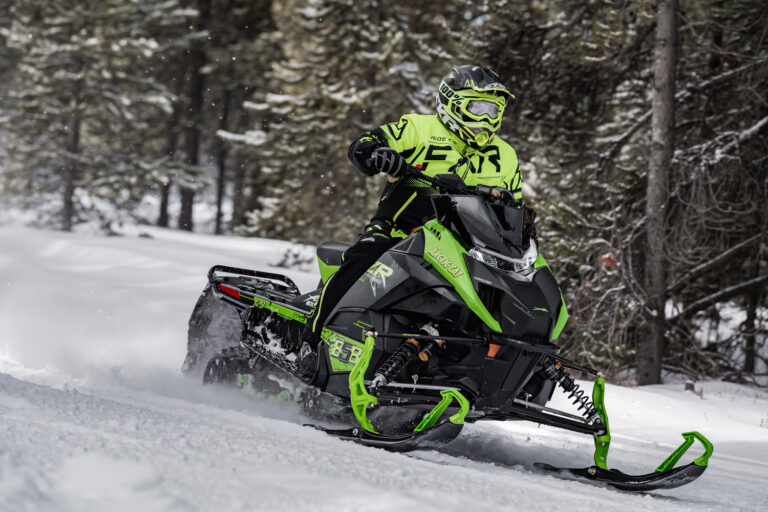
It’s pretty clear Arctic Cat has taken the spotlight the past six months with the impending launch of its all new C-TEC 2 858 stroker SDI 2-stroke twin. The engine is, of course, destined to propel AC’s very interesting and innovative CATALYST chassis in three track lengths.
Knowing these details we need to spend time drilling down on the other OEM’s and their potential to introduce something interesting in the coming season. Yeah, we’re talking limited build sleds.
Let’s have a look at Ski-Doo. Everyone knows Ski-Doo doesn’t let anyone mow its grass. This being a true statement we look for at least one – but up to three possibilities.
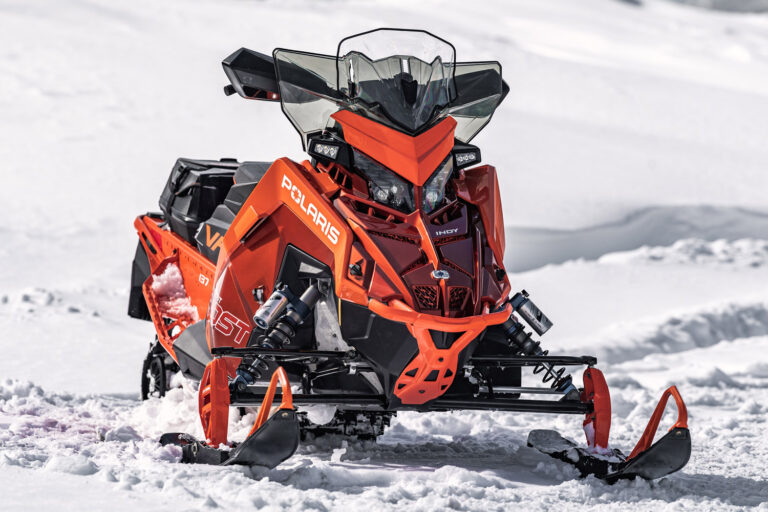
First: A no brainer. With the turbo trail 2 stroke genre capturing so much interest and sales success in such a short time, we look for Ski-Doo to match Polaris intro of the BOOST Assault for the 2025 model year.
This makes so much sense we have to think Ski-Doo will deliver a Backcountry X-RS 850 Turbo sometime this winter to go head to head with Polaris. Like we said – this just makes sense.
Second. We’ve beat this drum for at least two years. A Rotax 650 2-stroke to counter Polaris’s 650 Patriot engine used in myriad sled models. Here’s the beef. It’s not like the Rotax 600 in use right now is long-in-the-tooth. It isn’t.
However, the Polaris 650 does produce more HP than the Rotax 600 and in this biz we all know it’s all about who has the most – of everything. What’s the statistical odds this will come true? We’d say between sixty and seventy percent.
Third. This one might be a stretch, however, we think Ski-Doo may have another variant of its RAS-X trail independent front suspension. Why? We’ve been harping for a long time about how good the Polaris MATRYX IFS works in comparison to just about everything in the biz.
Would Ski-Doo tweak RAS-X this early in the Gen-5’s life cycle? Statistical odds on this happening would only be between twenty and thirty percent.
One of the many things I like about snowmobiling is making new discoveries. But it’s not often I’ve been gob-smacked, especially at a premier sledding destination like Québec’s Laurentides Region, where I thought I’d seen it all on several previous snowmobile tours.
Going on tour means encountering many factors that can make or break your ride. Variables include weather and snow conditions, trail routing and status, sled reliability, and the availability of appropriate services and accommodations when and wherever they’re needed.
Sure, good advance planning and preparedness helps, but even the most popular destinations can still be a bit of a gamble, especially for less experienced snowmobilers. So what if there was one place that provided remarkable peace of mind by eliminating most of the uncertainties?
That’s what we found in the Upper Laurentians, an area that sets a special benchmark that other destinations would be wise to emulate.
Signage like this at every intersection. Photo By: Martin Lortz
Staging From Mont Laurier
The Laurentides Region runs northwest from Montreal and the Lower Ottawa River almost to Clova and Parent. If you’re so inclined, you could ride all of its 2,411 kilometres (1,498 miles) of snowmobile trails, most of which meander through the snowy Laurentian Mountains. For our 4-day couples tour, we staged out of Mont Laurier (pop. 13,799), the gateway to the Upper Laurentians (Haute-Laurentides).
It’s a convenient staging hub for any Laurentides Region tour, with an outstanding network of trails spoking out in every direction. From there, multiple day rides and several loops are available so your sledding getaway can be as long or short as you choose.
Mont Laurier is also a real snowmobiling town, known for its many sled-accessible services and amenities, and for allowing snowmobiles to travel on snow along the south side of its main street (Hwy 117) that’s actually part of Local Trail 223. For those trailering in, Mont Laurier is only 187 miles from Massena, NY and 238 miles from Burlington VT. It’s also 250 km (160 miles) northwest of Montreal and 216 km (134 miles) north of Ottawa, most of it uphill as the elevation increases north of the Ottawa River.
Photo By: Martin Lortz
About The Wood Runner Trails & Loop
We chose Mont Laurier because I’d been wondering about something called the Wood Runner Loop (Le Tour Coureurs des Bois) that had caught my eye on the Laurentides Region snowmobile trail map. Turns out Le Tour Coureurs des Bois is an outstanding 464-kilometre (288 mile) circuit into the Upper Laurentians, north of Mont Laurier, that’s the showcase ride of the Wood Runner Trails (Les Sentiers Coureurs des Bois). As we quickly appreciated, unlike many loops marked on other trail guides, the Wood Runner Loop is much more than just a line highlighted on a map.
Each is named after the famous “coureurs des bois”, independent French fur traders from the 17th and 18th centuries. These “wood runners” ventured into the most remote areas, pushing the boundaries of the great unknown. Like its pioneering namesakes, the Wood Runner Trails explore a vast wilderness, taking adventurous snowmobilers on what for many becomes the ride of a lifetime.
The Wood Runner Backstory
So what makes the Wood Runner Trails so unique? It’s one of the only existing destination rides I’m aware of that’s initiated and championed by its hospitality providers, the area’s pourvoiries. The word “pourvoirie” is usually translated into English as “outfitter”. In winter, these Upper Laurentians outfitters cater to snowmobilers; the rest of the year, to hunters, anglers, ATV riders and vacationing families.
The best way to describe the pourvoiries associated with the Wood Runner Trails is authentic wilderness lodges with tasteful accommodations, modern amenities and gourmet cuisine for outdoor enthusiasts. Many snowmobilers prefer these pourvoiries to regular motels for a more special, enjoyable and memorable experience – one that they look forward to every night.
Almost twenty-five years ago, a few of these pourvoirie owners began attending American snowmobile shows to promote their area. Many stateside riders said that the Québec trail system was so big they hardly knew where to get started.
These Upper Laurentians outfitters also heard show attendees express uncertainty about trying an unfamiliar place, including such worries as finding reliable places to stay, being sure of good snow and trail conditions, getting lost, running out of gas, not speaking the language, or keeping their trucks and trailers secure.
Motivated by addressing these concerns, a group of independent forest innkeepers and outfitters decided to establish a unique network of snowmobile trails in the Upper Laurentians they named “Les Sentiers Coureurs des Bois”.
Over the years, they’ve enhanced their Wood Runner Trails concept with the cooperation of local economic development and tourism offices. They’ve also partnered with local snowmobile clubs for regular grooming, merged their trails into the FCMQ system, attracted visiting winter lovers from overseas, included a Mont Laurier staging hotel and sled rental partner, added reliable internet, and engaged in co-operative purchasing to provide the highest quality meals at each pourvoirie. Recently, they’ve also expanded the Wood Runner Trails to ATV, Side X Side and dual sport bike tours in other seasons.
The key to their long-term success stems from the continuing alliance of like-minded hospitality providers. Natural competitors, their ongoing cooperation has resulted in a more robust winter business for all, while attracting many more visiting snowmobilers to their entire region.
They’ve succeeded in delivering a one of a kind snowmobiling experience with reliable and secure access to their wilderness backyard, combined with unrivalled pourvoirie hospitality. Talk about a win-win for everyone!
Photo By: Martin Lortz
What You Can Expect From The Wood Runner Loop
The benefits of Le Tour Coureurs des Bois for snowmobilers are numerous. While each establishment is uniquely authentic in its own way, the pourvoirie accommodations, meals, service and amenities are all reliably excellent and consistent, including multi-bedroom chalets that can easily accommodate larger groups.
Most of these include living areas where our entire group relaxed comfortably together at the end of each day’s ride. My best advice: book your reservations early for the entire loop!
Each pourvoirie is also located close enough to the next that there’s no worry about running out of gas because fill-ups are available at each location. Each is also open for lunch and as rest stops for touring riders.
What’s more, the outfitters have installed 50 signage stations throughout their loop, with maps boards and arrowed destination/distance signs so wayfinding is a breeze and because these owners work together, visiting riders benefit from knowing that their hosts are used to keeping track of guests riding between their pourvoiries – and that help is available if needed.
Meanwhile, their easy-riding Wood Runner Loop travels through beautiful forests, with few public road crossings or ice travel. Numerous secondary trails within and around the main loop provide alternate routes for longer or shorter ride distances. Cell service can be spotty on remote trails, but trail signs indicate a few points where service is available, in addition to each of the pourvoiries.
Then there are the special attractions. Le Tour Coureurs des Bois accesses the famous Montagne du Diable (Devil’s Mountain) lookout with its new “dare-to-climb” panoramic tower view from the Laurentians second-highest peak.
Nearby, the picturesque Chute de Windigo (Windigo Falls) with a height of 55 metres and width of 18, is well worth a look in its scenic setting. And just to the west of these points of interest is the massive Baskatong Reservoir, where a staked Regional Trail 322 takes you for a quick, 12-km, staked ice crossing to a Sentiers Coureurs des Bois member located on the other side.
Home Away From Home
There’s one intangible benefit that’s equally responsible for bringing satisfied snowmobilers back to visit the Upper Laurentians again and again. Les Sentiers Coureurs des Bois members give everyone a warm, personal welcome and can cater to every need in English.
Each pourvoirie specializes in making your stay and ride as easy, comfortable and enjoyable as possible, starting with several choices for secure trucks and trailer parking (see list). We even had our sleds cleared of snow in the morning by staff using a leaf blower!
Their hospitality also results from working together for continuous improvement and plain-spoken honesty with guests about snow and trail status, even going so far as to advise sledders with reservations if necessary. And nothing compares to the scrumptious meals that are part of every snowmobile package: high cuisine that’s artistically plated by gourmet chefs, then served by super friendly pourvoirie staff.
Yes, when you stay with these go-above-and-beyond outfitters, you’ll feel right at home, make enduring friendships, and keep coming back for more because it just doesn’t get any better than this on every day – and every night – of any other tour!
That’s why Le Tour Coureurs des Bois is now on my list of “Fav Québec Snowmobile Destinations” – and is a perfect choice for riders of all ages and experience levels, and especially for a couples tour like ours. Another plus is that due to its northerly location, the Wood Runner Loop is normally available to ride both before and after the season ends in many other places.
Consequently, and because it’s much closer to Ontario and several border states than some other Québec locations, I’ve also added it to my short list of early and late season riding possibilities.
For me, all of this is what makes Le Tour Coureurs des Bois a new dimension in Québec trail riding, one that may even change trailering patterns for avid snow-seekers looking for unbeatable first and last rides.
So along with everything else that Mont Laurier and the Upper Laurentians have to offer touring snowmobilers, why not try the Wood Runner Trails for your next ride?
Certainly my Intrepid Snowmobiler crew, hard to impress after years of visiting many popular snowmobiling destinations, were blown away by the ultimate ride experience we enjoyed in the Laurentides Region, thanks to the Wood Runner Loop and its amazing pourvoiries!
Luke and Mark set out on a 100 Mile (160 km) trail ride on a pair of Taiga’s Nomad Electric Snowmobiles to demonstrate their real-world capabilities and experiences using the electric charging network which is integrated into 5,000 km’s of Quebec’s Snowmobile trail network.
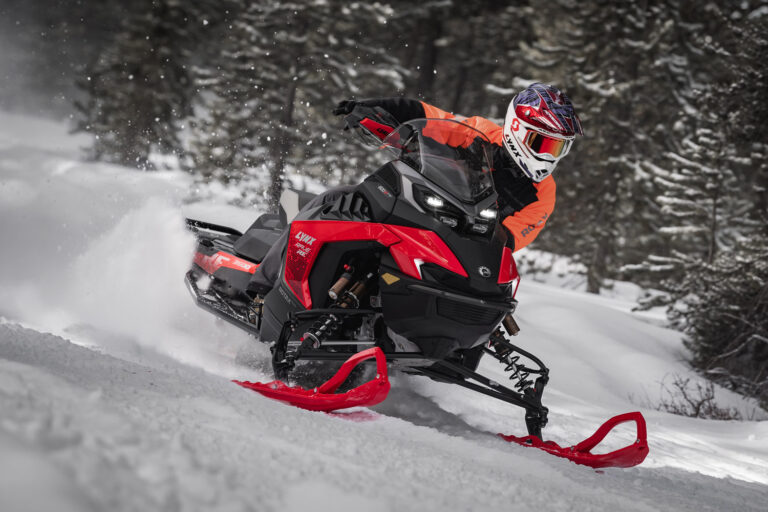
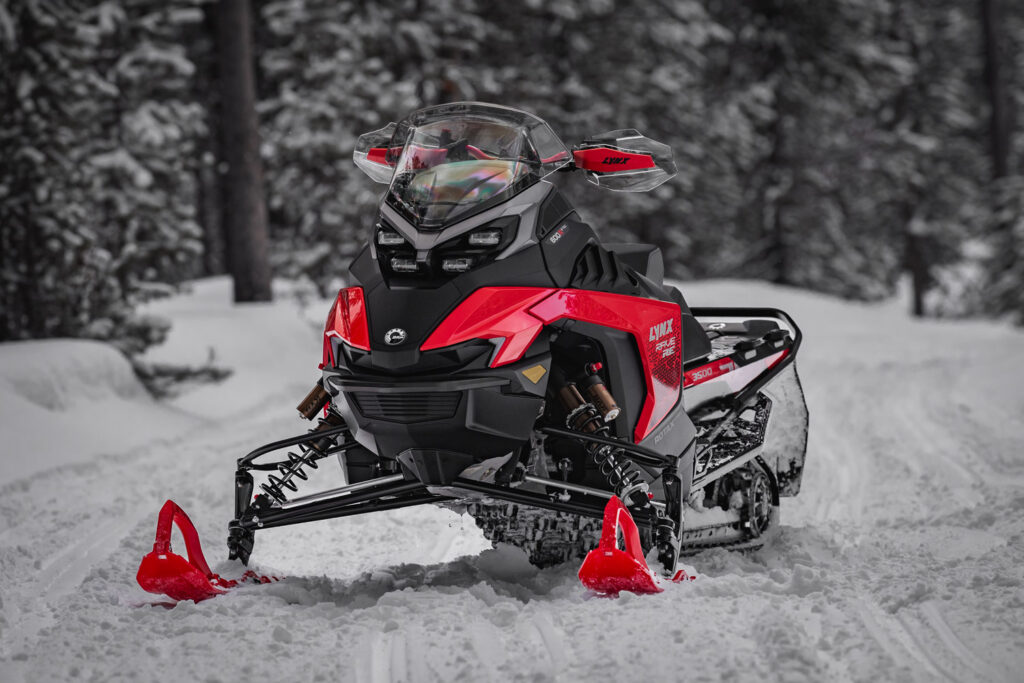
New radical rear suspension. Improved ergonomics. Built even tougher. The new Lynx Rave RS racing snowmobile is poised to extend its championship streak, setting the standard for its competitors on European racetracks. The Rave RS has recorded the fastest lap times on each test track, when a comparison has been made with previous model years and competing brands.
The New rCTRL Rear Suspension
The design of the rCTRL (center-to-rear-linked) rear suspension focused on enhancing rollability and increasing damping capacity, enabling the Lynx Rave RS snowmobile to achieve faster laps on snocross tracks. Durability has been improved, and maintenance has been simplified.
The revolutionary rCTRL rear suspension is based on a unique coupling system. In this mechanism, the center arm borrows damping force from the rear arm through the shock absorber to the center arm area. This unique solution provides the center arm with increased damping power without an excessively stiff center shock.
The center arm plays a pivotal role in modern snowcross racing, as the rider’s and sled’s mass is centralized in a smaller area on the middle of the sled, subjecting the center arm to substantial forces. The rear arm of the rCTRL suspension operates independently at all times, with force applied solely to the rear arm. For instance, when the sled lands with rear weight after a jump, the rear arm smoothly follows the landing, without slamming down the front end of the sled.
The carrying capacity of the rear arm is guaranteed by using a long shock absorber with a total dimension of 590 mm and a stroke length of 175 mm. The long stroke allows the suspension open more, giving more damping force on the landing of jumps. In addition to high damping capacity and carrying capacity, the advantages of a long damper are also easy adjustability.
Thanks to the new geometry of the rCTRL rear suspension, the Rave RS rolls significantly better than its predecessor, especially when riding on bumps. Due to the small variation in the track tension, the pre-adjustment of the track tension can be left looser than before without the track ratcheting.
The slide rails of the rear suspension are machined to their shape from aluminum profile. The center arm is attached to the frame with a fork, which means that to remove the rear suspension, it is enough to simply loosen the bolts of the rear arm and pull the rear suspension out. Parts have been reduced in the name of maintainability and weight saving: the number of parts is reduced by a third which means a weight saving of 5 kg compared to its predecessor. The rCTRL rear suspension is now more service-friendly and faster to maintain, much to the relief of racing team mechanics.
The limiter strap is located outside the suspension, and adjusting the strap does not require opening the strap loop. The bolts of rear suspension are standardized and fewer different tools are needed for maintenance than before. The bolts are placed in such a way that they are easily accessible from the outside of the suspension. The attachment of the rear arm to the slide rails is done by slide sleeve.
The LFS Racing front suspension of the Rave RS racing sled uses new, taller spindles. The change goes hand in hand with the new rCTRL rear suspension, bringing 27 mm more ground clearance under the lower A-arm. As part of the reform of the sled’s suspension, the swaybar has been removed, which contributes to the sled’s weight savings.
Renewed Radien-RS Chassis
The Rave RS 600RS E-TEC has also experienced significant reforms in terms of the structure of the chassis. Four-point engine mounting, lower located running boards and further strengthened structure mean increased performance, better handling and enhanced reliability.
The fierce powerhouse of snowcross tracks, the Rotax 600RS E-TEC engine, is now mounted to the chassis via four attachment points. The alignment of the powertrain is now more constant due to the stiffer engine mounting, which improves the efficiency of the transmission and thus increases the performance even more.
The S-module of the front frame has been strengthened with a new, straight crossbar and new reinforcements. The running boards are 30 mm lower than before, which brings the center of gravity lower, making cornering easier and helping the rider to get support from the sled when jumping. At the same time, the rider’s foot holders have been brought back 5 cm. The disc brake cover features additional perforation to improve the cooling of the brake.
The new calibration of the engine optimizes the performance in line with other innovations of the Rave RS factory racer: more power, more speed on the track. The ignition coil and the Rave motor have been repositioned lower on the chassis than before, which lowers the center of gravity and keeps the important components better protected.
Thanks to the new bearings in the chain case, removing the drive shaft is much faster and easier than before. In the future, the track can be replaced without disassembling the chain case, which makes the maintenance staff’s race weekends significantly easier.
Thanks to the more evenly shaped chassis and larger ground clearance, the bottom of the sled hits the snow less often than before, improving the progress of the sled on soft tracks. The rCTRL rear suspension is attached to the rear chassis with a fork-type lug, which distributes the force more evenly to the bearings.
The redesigned RS seat has been brought 30 mm lower along with the running boards, which, together with the chassis changes, lowers the center of gravity.
Lynx Rave RS 600RS is built on Radien-RS chassis and its uniqueness is the short rear chassis and the flexible rear part made of polyethylene. The flexible rear part, unlike the aluminum tunnel, is easy, quick and inexpensive to change in case of damage.
Aiming to Continue The Championship Streak
Lynx Rave RS has been number one on European snowcross tracks for years. In the spring 2023, the Finnish Aki Pihlaja achieved the coveted world championship title with the Rave RS in Kirkenes, Norway, and is eager to renew the title in the 2024 season.
Lynx was by far the most successful racing sled also in the Scandinavian national series: Rave RS riders achieved a total of 12 championships in the 2023 season, complemented by more than 20 podium places.
The completely renewed Lynx Rave RS 600RS E-TEC race sled has gone through a tough test program by front row drivers. The project and test group has included riders who have achieved a total of nearly one hundred prestigious race medals.
2024 RAVE RS 600RS E-TEC HIGHLIGHTS:
● Renewed Radien-RS chassis ● Re-calibrated Rotax 600RS E-TEC engine ● New rCTRL rear suspension ● Renewed LFS Racing front suspension ● KYB PRO RS 46 HLCR Kashima shock absorbers ● 381 x 3487 x 44 mm track ● 1092 mm ski stance ● Racing pDrive -primary clutch ja Team TTS-04 driven clutch ● 4-piston Brembo Racing brake with improved cooling ● Pilot Racing skis ● Renewed RS seat ● New coloration
I get a chuckle listening to committed vintage aficionados who, for the most part, were just a twinkle in their mom and dad’s eye when some of these classic sleds appeared on the landscape.
Since I’ve been around a while I can recount and document with firsthand experience how these vintage sleds impacted the snowmobile marketplace of the era. Of significant interest is the Yamaha Enticer series.
First arriving on the scene was the sled that changed the sport: the 1977 Yamaha Enticer 250. Many connoisseurs of all things Yamaha do not realize there was a very limited run of the original ET 250 for the 1977 model year.
It’s challenging to identify a real ’77 – here’s the simplest way to do it. The 1977 limited-build ET 250 did not have a dash mounted decompressor. Check out the decompressor toggle on a ’78 to fully visualize this descriptor of a 77.
Why is the ET 250 the “snowmobile that changed it all?”. When Yamaha first came to the market with the ET 250 the company literally shifted the paradigm that told the market what a snowmobile should be. Take oil injection. Yamaha arrived on the snowmobile landscape in the late 1960’s and every sled it sold was so equipped. Only racing destined rides like the original liquid cooled 440 SRX was premix. This feature alone caused this writer to hurry down to my local Yama-store and pick up a copy for the ridiculous sum of $1,249.00 Canadian. US ET 250s were $999.00 retail.
The ET 250 was light as a result of the liberal use of aluminum in the tunnel, body fenders and belly. The sled would pull heroic wheelies whenever you whacked the throttle and called up all 23 ponies. Sounds ridiculous doesn’t it? The 250cc single cylinder 2-stroke was a rumbler at idle but was smooth-as-silk once underway.
Its 28-inch ski-stance gave the sled a solid on-center feel and we (myself and a legion of friends who bought ‘78 ET 250s) could carve the twisties – outrunning sleds with way more HP. The ET 250 brought a new level of comfort to the sport. All Yamaha sleds at this time featured ultra-plush, foam seats covered with a grippy, stretchy cover.
Underneath the ET 250 was another game-changing feature – a molded rubber 15-inch-wide track with fiberglass rods imbedded in the carcass. These rods carried hardened steel clips for the slide rails to “slide” on.
The industry standard to this point were “built” tracks using three rubber belts (left, right and center) held together with riveted steel grauser bars. These built tracks were noisy, prone to grauser bar breakage and, unless studded, not particularly great at producing traction.
The ET 250 came with an unusual steel rail skidframe with a gas cell shock on the rear arm with torsion springs and an undamped torsion spring front arm. The skid looked odd but delivered a ride that flat-out drove around the skid’s used by Arctic and Polaris at the time.
Up front it was leaf springs but the front edge of these springs slid on friction eliminating UHMW blocks generating unheard-of leaf spring ride quality.
Here’s two important features of not just the ET 250 but every Yamaha sled of this era. Quality and reliability. The ET 250 was just about indestructible. Believe me, my friends and I tried to break an ET 250 with motocross antics and endless wheelies – but to no avail. That 250cc mill would pop to life on the coldest mornings and never, ever fouled a plug doing so. Even belt life was good despite a “secondary on tunnel chaincase” transmission design.
Another feature the competition had not brought to the market was matched-die fiberglass hoods. This process is similar to how Yamaha builds watercraft hulls. The bottom line is the inside of the hood was as smooth and warp-free as the outside. Competitive hoods continued to look like someone troweled wet kitty fur on their underside.
Yamaha brought so much that was new in MY 1978 the competition struggled to include the many value-added features on their comparable priced sleds. The ET 250 was the shot across the bow for the other players in the market. As a result they struggled until the end of the 70’s to match Yamaha’s Enticer series for value.
Arriving in rapid fire succession Yamaha upped the ante in the industry with the Enticer 340 twin and then the Enticer 300 twin. Both these sleds helped cement the reputation the ET 250 had established.
Stay tuned! There’s more to come on iconic Yamaha’s of the 70’s and early 80’s.
KLIM, the global leader in technical riding gear and apparel, is proud to achieve a new level of performance with the redesigned Adrenaline Pro S GTX BOA Boot, a mountain-focused technical snowmobile boot for the most aggressive riders.
Continuing the legacy of the industry-first Adrenaline GTX Boot, the boot that redefined snowmobile boots when first released in the early 2000s, the Adrenaline Pro S GTX BOA Boot continues the successful Adrenaline Boot lineup with a complete ground-up redesign, a new custom-developed Michelin outsole, the convenience, ease and compression of a dual-zone remote dial BOA system and improved lace routing for added comfort on the running boards.
The most popular boot in snowmobiling is now more supportive with stronger dual-zone BOA dials, designed to pop off and reattach rather than break off, combined with a molded tongue for improved closure force and lace force distribution for better ankle support.
Through multi-year testing and validation to find the correct combination of durability and traction, the new Michelin outsole, engineered specifically for powersports and custom-developed with a proprietary sole pattern, provides heavy-duty grip and durability for traction in the winter.
With six distinct colorways and 600 grams of 3M THINSULATE Insulation to reflect and retain heat while offering virtually zero moisture absorption, meaning it will continue insulating even when wet, the 2023 Adrenaline Pro S GTX BOA Boot also includes a removable moisture-wicking OrthoLite insole, an updated breathable, moisture-wicking liner and half-size inserts for adjustable fit.
Designed and developed in Rigby, Idaho, KLIM is committed to developing performance-driven products that enhance the riding experience in the most demanding conditions.
TOP BENEFITS:
• Support and comfort with dual-zone BOA systems • Long lasting durability and grip with Michelin outsole • Keep your feet warm, dry, protected
FEATURED SPECS:
• GORE-TEX • GUARANTEED TO KEEP YOU DRY • 3M Thinsulate Insulation • Leather upper w/ reinforced rubber toe & heel • Michelin rubber outsole for grip & durability • BOA dual-zone lacing system • BOA dial & lace warranty guarantee • Breakaway dial failsafe prevents breakage • Molded tongue and sequence lacing distributes closure force evenly • Removable moisture wicking Ortholite insole • Half-size insert for adjustable fit
COLORS: Black, Black – Fiery Red, Black – Safety Yellow – Asphalt, Black – Electric Blue Lemonade – Asphalt, Black – Knockout Pink – Castlerock, Black – White – Castlerock
Luke provides a detailed overview of Arctic Cat’s 2024 Riot 600 in the CATALYST platform featuring the 600-Class C-TEC2 Engine and CROSS-ACTION 146-inch Rear Suspension.