Home Blog Page 184

Polaris Takes the Plunge in a Big Way

0

Polaris Industries Inc. (NYSE: PII) today announced the company, through its employees and matched by The Polaris Foundation, raised almost $30,000 for Special Olympics Minnesota.

The company also donated two snowmobiles which will be offered at raffle by the organization.

“Polaris is proud to lead the way in fundraising efforts for the Special Olympics Minnesota’s Polar Plunge,” said Scott Wine, Polaris Chairman and Chief Executive Officer. “This organization provides wonderful programs for more than 8,100 Special Olympic Minnesota athletes and I’m pleased our employees embraced the cause in such a big way.”

As part of the fundraising effort, Polaris employees had the No. 1 team with 110 “Plungers” from the organization participating at the White Bear Lake Plunge, on Saturday, January 31.

The event saw more than 8,000 attendees, consisting of Plungers and spectators, who spent the day watching the Plunge, snacking on food, meeting Snowflake, the Plunge mascot, and checking out Polaris’ new ground-breaking on-road vehicle, Polaris Slingshot.

The White Bear Polar Plunge was only the second of several Plunges happening around the state. Interested parties can find more information at plungemn.org. People interested in the snowmobiles being raffled by Special Olympics Minnesota can find more information at www.plungemn.org/polaris-raffle or by visiting any of the upcoming metro Plunge locations to purchase a raffle ticket.

Polaris is a recognized leader in the powersports industry with annual 2013 sales of $3.8 billion. Polaris designs, engineers, manufactures and markets innovative, high quality off-road vehicles, including all- terrain vehicles (ATVs) and the Polaris RANGER and RZR side-by-side vehicles, snowmobiles, motorcycles, and on-road electric/hybrid powered vehicles. Polaris is among the global sales leaders for both snowmobiles and off-road vehicles and has established a presence in the heavyweight cruiser and touring motorcycle market with the Victory and Indian Motorcycle brands. Additionally, Polaris continues to invest in the global on-road small electric/hybrid powered vehicle industry with Global Electric Motorcars (GEM), Goupil Industrie SA, Aixam Mega S.A.S., and internally developed vehicles. Polaris enhances the riding experience with a complete line of Polaris Engineered parts, accessories and apparel, Klim branded apparel, and ORV accessories under the Kolpin and Cycle Country brands. Polaris Industries Inc. trades on the New York Stock Exchange under the symbol “PII,” and the Company is included in the S&P Mid-Cap 400 stock price index.

Information about the complete line of Polaris products, apparel, and vehicle accessories is available from authorized Polaris dealers or anytime at www.polaris.com.
Cold Winter Good for Ontario Snowmobiling

0

In a customer survey last spring, 95.8% of respondents said that Ontario snowmobiling is enjoyable, very enjoyable or extremely enjoyable.

So for a second consecutive winter, the not for profit Ontario Federation of Snowmobile Clubs (OFSC) is pleased to report that over 30,000 kilometres (95.5%) of its snowmobile trails are available for snowmobilers to enjoy in February, including Ontario’s Family Day Long Weekend. With continuing cold temperatures in the long-range forecast, Ontarians could have OFSC trails to ride right through the March Spring Break.

The OFSC’s extensive trail system provides more kilometres of snowmobile trails than there are kilometres of provincial highways. It offers excellent sledding opportunities for local residents, touring riders and out of province visitors in every snowbelt region of Ontario.

Consequently, the popularity of snowmobiling is growing, with participation up 21% last season, including a significant resurgence of new participants and the highest number of permitted sleds in the past ten years. Sled manufacturers also report that Ontario new sleds sales increased by 21% in 2014 and that many dealers are sold out of 2015 snowmobiles.

“This growth is only possible because our 213 clubs and thousands of volunteers prepare, maintain and operate a truly world class trail system that’s second to none,” commented Remi Sauve, OFSC president. “It’s an amazing accomplishment and we welcome everyone to go snowmobiling to discover the winter wonderland that’s been created for their enjoyment with Mother Nature’s cooperation.”

To keep trails as smooth as possible, OFSC snowmobile clubs operate about 352 heavy industrial groomers for over 90,000 hours each winter. With an estimated total fleet value of $26.3 million, these groomers are similar to those used on ski hills.

With the International Snowmobile Manufacturer’s Association reporting that the average snowmobiler rides about 2,600 kilometres each winter, it’s estimated that OFSC permit holders and their families logged in excess of 200 million kilometres on OFSC trails last season and are well on their way to achieving that milestone again this year.

“By most measures, snowmobiling is Ontario’s premier winter tourism activity. We offer trails in almost every part of the province, the opportunity to travel by snowmobile from community to community, and for riders to see sights and places that can only be reached and appreciated in the winter,” said Paul Shaughnessy, OFSC executive director.

With an economic impact of $1.7 million annually for the benefit of winter tourism in Ontario, OFSC snowmobiling is also a major contributor to the wellbeing and sustainability of many winter businesses and rural communities. The OFSC invites more Ontarians to buy a trail permit and discover snowmobiling this winter at www.ofsc.on.ca.

The Ontario Federation of Snowmobile Clubs is a volunteer led not-for-profit association, which through strong leadership, provides a wide range of quality programs and services to and on behalf of, its member organizations

WINDSHIELD MYTHS BUSTED

0

Low windshields on trail snowmobiles have been a bone of contention around the sunny offices of Supertrax for a few years.

Yes, we see the merit of a super-low windshield on mountain or freestyle sleds being ridden in powder, but what’s the deal with OEMs putting those “thong” windshields on trail sleds?

It seems a lot of snowmobilers think they’re actually penalizing themselves by having a mid-height windshield on their sled. They argue their sled actually goes faster when they have a low windshield on it and a higher one would slow them down.

This sounded fishy to us and, despite the fact the low windshield look seems like it’s more attractive and adds speed, we weren’t convinced.

We spoke to an aerodynamics expert about this and he told us the most aerodynamic thing on a snowmobile is actually not on the snowmobile. It’s not the hood, not the windshield, but rather the rider’s helmet.

The least aerodynamic thing is the rider’s body. Anyone who has blasted a lake at the C-note with a low windshield knows how much air resistance there is pushing against your chest, almost like a giant hand trying to push you off the back of the sled.

So, logic would tell you, a good windshield that directs air to the upper half of your helmet and away from your body would be the best way to overcome aerodynamic drag. Less drag means more top speed and that’s the biggest hold-back for so-called “windshield-wise” riders who want to go faster.

Certainly a windshield that’s too tall or too large works against the principle we’ve outlined, but there are plenty of good ones from every manufacturer that will not only give you a more slippery profile but will keep you warm and comfy all day, too.

Best Crossover Snowmobiles

0

SnowTrax Television Co-Host Luke Lester helps decipher the confusing crossover snowmobile market by outlying what sets each sled apart and which one might be right for your type of riding.

Subscribe to our YouTube Channel!

A TALE OF TWO TURBOS

0

Last weekend we rode two turbocharged sleds back to back for 140 miles, a 129-inch 9000 Series Cat stocker and a Viper SE with an MPI aftermarket turbo kit prepped by Yamaha Canada. We were surprised and impressed.

Earlier this month you read our report on our experience riding our 2015 9000 Cat back in December and how buzzed we were with the sled’s seemingly endless supply of power and torque.

Frankly, we were unable to reach the sled’s top speed given the distance and icy conditions we were testing it on. We did see 118-mph, however, and decided that was good enough for that day.

Naturally we were skeptical about the Yamaha’s ability to keep up with the Cat and were doubtful an add-on turbo could make the Viper perform anywhere near close.

We ran the daylights out of both sleds on several hard-packed lakes, drag racing them when the coast was clear and came away impressed. The sleds were dead even – almost within a sled length every time we ran them head-to-head. One time it would be the Cat, the next time it would be the Viper.

When we compared the drive-ability of the two sleds we were really blown away with the Viper. Throttle tip-in was very linear and predictable – not much different than a stock EFI 1049 – until you pinched the flipper to the bars and then the sled just rocketed away.

We found the power delivery was much nicer than the 9000 when trail riding and the sled even felt way lighter over the skis. As a matter of fact, the Viper felt lighter overall, period.

We’re not sure if this is because the 1049 is a bit lighter than the 9000’s 1056 twin (it is), or if the Yamaha turbo kit has less paraphernalia than the 9000’s, or both. It could also have been the skidframe’s front arm settings taking some weight off the skis, dunno.

We also noted less residual turbo noise taking place under the Viper’s hood as the waste gate opened and closed on the turbocharger and as pressure was popped-off. Keep in mind, the stock Viper is a throatier sounding sled than the 9000 but we didn’t find it to be a lot noisier than a stocker.

All in all, the Viper with a turbo is like a puppy dog on trails and turns into a monster when you get it out in the great wide-open. Clutching was flat-out excellent.

We rode it hard all day and the sled ran and performed exactly the same at the end of the ride as when we began. Worthy of note was that we all agreed the rear suspension calibration was much better on the 9000 but the overall driveability of the Viper was truly impressive.

We think the 1049 triple with a turbo would be a great and logical substitute for the current Suzuki twin in the Cat someday and who knows, maybe even as a super-performance Yamaha production sled.

TEAM ARCTIC FIRST AND SECOND AT SOO 500 ENDURO

0

Team Arctic relied upon its speed, durability and top-notch racers and crews to conquer the famed Soo International 500 Enduro in convincing fashion, finishing first, second and eighth aboard production-based Arctic Cat snowmobiles.

Taking the win was the Factory Team Arctic/Christian Brothers Racing pair of Brian Dick and Wes Selby, with Cadarette Racing’s Troy Dewald, Chad Lian and Cody Miaskoch finishing in second place.

Eighth went to Christian Brothers Racing’s Ryan Simons and Zach Herfindahl. All three teams were competing aboard an Arctic Cat ZR 6000R with the ProCross chassis and powered by Speedwerx-modified Arctic Cat 600 C-TEC2 EFI engines.

“Our racers and their teams delivered a historic performance at the famed event,” said Mike Kloety, Team Arctic Race Manager. “The race ended at 282 laps because of dangerous visibility due to snow. Brian and Wes led for 133 laps, which was more than any other team. Ryan and Zach also led the race on two occasions, while Cadarette Racing positioned themselves perfectly to challenge for what might have been their second win at this event aboard Arctic Cats.”

“Everyone wished they could have raced the full 500 laps. Our sleds were very fast and set up for the course to keep getting rougher, the teams were prepared and the drivers were determined. The only thing that would have changed with another 218 laps was that the #52 team of Ryan and Zach would have moved back into the hunt.”

Team Green’s contingent of snocross racers delivered an equally impressive performance at the fifth stop of the ISOC National tour in Salamanca, NY, where they notched victory in five of 15 classes.

Tucker Hibbert resumed his penchant for winning everything he entered, taking both Pro Open wins. Logan Christian put himself on the podium for the first time this season with a powerful third place finish in Friday’s final, then came close to doing it again with a forth on Saturday. Other Team Arctic winners in New York included Lee Butler, Dan Benham and Carson Alread.

The next stop on the 2015 ISOC National tour is Feb. 20-21, 2015, at Route 66 Speedway in Chicago.

Arctic Cat Inc., based in Thief River Falls, Minn., designs, engineers, manufactures and markets all-terrain vehicles (ATVs) and snowmobiles under the Arctic Cat brand name, as well as related parts, garments and accessories. Its common stock is traded on the NASDAQ National Market under the ticker symbol ACAT.

More information about Arctic Cat and its products is available on the Internet at arcticcat.com.

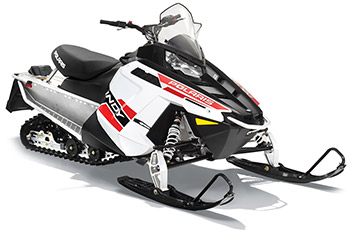
RIDE IMPRESSION: 2015 Polaris Indy 600

0

We’ve been singing the praises of the Indy 800SP for a while now and have spent less time focusing on the Indy 600 – especially the base model.

This year we have a baseline Indy 600 in our press fleet and we’ve had a good chance to wring it out and appraise its goodness.

Our first impression is this sled is very light. It feels light and it is light at 449-lbs dry weight.

We’re also impressed with its riding position and rider comfort. You sit higher on this sled and can really see the trail from the driver’s perch. Even with this seating position, the stock windshield is excellent and provides great face and hand protection – even at lake speeds.

Inputs into the handlebars are light and the front end stays nicely planted in corners without much ski-lift under hard cornering. It rails very flat and predictably and the 600 Cleanfire mill is decent on gas (if ridden at trail speeds) and it also delivers acceptable oil mileage. Power is good although the new AXYS 600 feels way faster.

We really notice its shock-in-skid rear suspension is not up to par with the SP or especially, the AXYS. Its skid uses gas cell Motion Control shocks that work well on mild chop and at reasonable speeds but when the going gets deep or speeds increase over washboard, these shocks have their hands full.

The only adjustment you get at the rear is spring preload and we’ve found it’s impossible to get great suspension performance simply by adjusting preload. We’re currently playing with the couplers to get a bit more compliance at the bottom of the suspension’s stroke but, if you’re riding aggressively we’d suggest you pay a bit more and move up to the SP. It’s shock package is way better and it has more adjustability.

As it is, the Indy 600 is extremely good value with its only flaw being its skidframe suspension – or more specifically, its shock package. Like we said, we may be able to get it to work better, but the way we feel now we’d gladly opt for the better-suspended SP.

WHAT’S THE BEST TRACK LENGTH?

0

There’s been much discussion recently about whether 120-inch sleds should move to 137-inches or follow Cat and Yamaha’s lead to move trail sleds to 129-inches.

Ski-Doo recently announced a limited build 2015 MX-Z Iron Dog with a 128-incher and many riders think this is the way things should go. Here’s our take on the subject.

We’ve been very vocal about our support for 137-inch tracks. The versatility you get with a longer track (but not too long) is substantial and since snowmobiling is about more than just trail riding, it makes sense to have enough floatation to be able to ride in powder occasionally. “Occasionally” is actually the key word here.

You need to ask yourself if the mogul bridging effect of a longer track combined with its slightly slower turning ability is enough of a trade-off to suit your riding style. Remember, those 120’s really can crank it on the trails and in tight stuff, their response and turning effort is very noticeable.

It’s actually one of the reasons we like the concept of a 128 or 129. It’s almost impossible to tell the handling difference apart from a 120 and yet you get considerably more floatation with the extra track.

This is very noticeable on sleds that are already light like the Iron Dog compared to a standard MX-Z. We’ve noticed the featherweight 120 MX-Z works surprisingly good in powder and although not ideal, can get the job done.

What about off-trail slanted crossovers? There’s a strong leaning toward 141-146-inch tracks for freestyle and semi-off-trail targeted sleds. Frankly, we feel the more track there is, the less maneuverability you get.

Longer tracks are flat-out harder to turn. We like the 141 because it offers a nice balance of floatation and steering ease, but, with the clutching and engine packages available for today’s sleds you can go heavily into powder with a 137 and not get stuck. True, flat-out hill-climbing is limited on a 137 but it all depends where you’re riding.

There are plenty of choices out there but you need to remember to ask yourself how you really ride, where you ride and then realistically consider the things you like about a sled before you dive in with a track that might be too short – or too long.

TEST RIDE: 2015 Ski Doo Summit X T3 174

0

SnowTrax Television Co-Host AJ Lester evaluates Ski-Doo’s 2015 Summit X featuring T3 technology and a super long 174 inch track spinning 3-inch lugs.

Subscribe to our YouTube Channel!

SETTING UP YOUR VIPER’S AIR SHOCKS

0

We’ve discovered a few tricks getting our Yamaha Viper X-TX riding better and wanted to pass the info on to you while the snow is down.

First, we’ve been really impressed with how well the Arctic Cat Sno-Pros are riding this year. At the same time we were not that pleased with the ride results from our Viper X-TX SE.

To be fair, the X-TX is not targeted as a pure trail sled but rather is more at home riding powder. However, you usually still have to ride trails to get to your fave powder location and the ride can jar all your tooth fillings loose getting there.

Back to Arctic Cat: This year Cat’s engineers changed the damping rates and air pressure settings on a number of their 129, 137 and 141-inch sleds to get them to ride more smoothly. We had assumed the same settings prevailed with Yamaha but they do not. We got out our air pressure pump (the one supplied in the tool-kit) and found that Cat’s air shock settings for the front were 72 to 75-psi, depending on the model.

We then checked the Viper and found the settings were 90 to 95-psi. The front end of the Viper was sitting way high and it was hard to get any static movement in the front shocks at all. When we dropped the air pressure down to 75-psi on the front shocks, the Viper sat a bit lower and there was nice movement in the shocks over washboard and chatter bumps. So far we’ve experienced no bottoming issues.

We didn’t change anything with the center coilover gas shock but checked the air pressure in the rear shock and found it to be 137-lbs. of its maximum allowable 150. We immediately dropped the pressure to 100-psi and got some nice movement in the skidframe.

The sled’s ride was vastly improved and so far we can’t see that it’s negatively affected the deep-snow performance of the X-TX at all. One thing’s for sure: The sled is way more compliant on trails.

We’d recommend these changes for anyone whose body weight goes up to about 200-lbs and if you find you need more air pressure in the rear we’d only bump it up in 5-lb increments to a max of about 115-psi with no rider, sled on the ground. If you’re bottoming out at that pressure level, you need to go on a diet!

BTW: Using this pump is a breeze. Honestly, it doesn’t take any longer than checking the tire pressure on your pick-up and the pump is very accurate. The hardest part is knowing where to begin with pressures and we’ve just supplied that for you.

Good luck.